Introduction
Peptides have become an increasingly important area of modern biomedical science. The use of peptides in the processes of hormone regulation, immune system activity, tissue repair, metabolism and other vital functions in the body of humans has been discovered by scientists during the last decades. Peptide research now spans molecular biology, drug discovery, diagnostics and the development of peptide-based medicines.
Although peptides are frequently discussed in scientific literature and healthcare publications, their meaning is not always clearly understood. Terms such as amino acids, peptides, proteins, peptide hormones and research peptides are sometimes used interchangeably, even though they describe different molecular concepts. However, in reality these words relate to different aspects of molecular biology.
Peptides, by their basic definition, are molecules that consist of amino acids put together in a particular order. Though they might seem rather simple from the structural point of view, the diversity of their functions is amazing. For example, there are peptides that serve as hormones, which regulate blood sugar levels, appetite, or growth. There are peptides that assist in immune cell communication during infections, wound healing, or cell proliferation and interaction. Thus, peptides’ unique binding ability to their target makes them useful to scientists and pharmacologists.
The interest in research peptides has grown significantly over the last decade, particularly across UK universities, biotechnology companies and pharmaceutical laboratories. Advances in peptide synthesis, HPLC testing and LC-MS analysis have made research peptides increasingly valuable for scientific investigation.
It is important to understand that not all peptides are medicines. While some peptide medicines have received regulatory approval, many research peptides are supplied strictly for laboratory investigation. Across the UK, research peptides are commonly studied in universities, biomedical research centres and pharmaceutical laboratories under Research Use Only (RUO) conditions.
The following guide is intended to provide a scientific explanation of peptides, their meaning, formation, comparison with proteins, and the importance of peptides in biomedical research. All information included in this article is taken from reliable scientific resources such as PubMed and Nature as well as MHRA.
What Are Peptides?
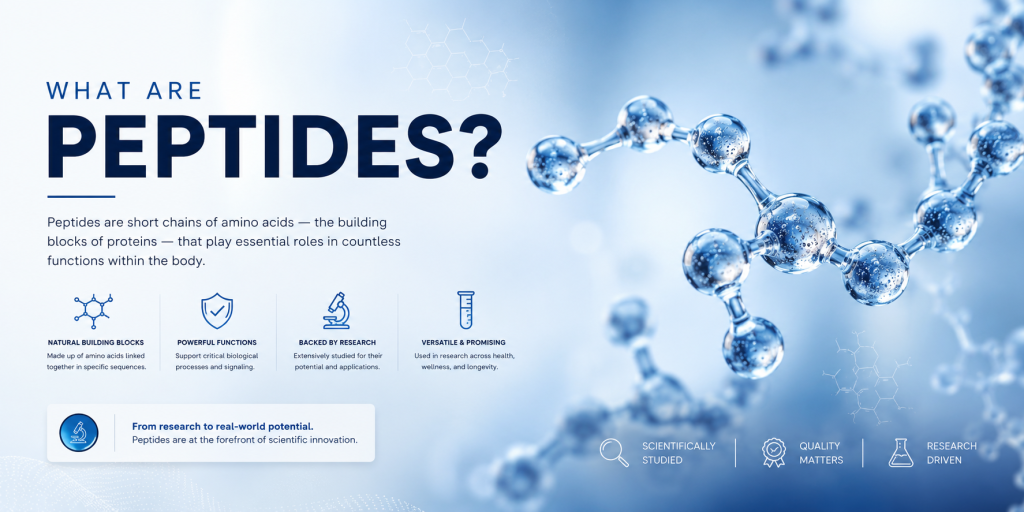
A peptide is a molecule consisting of several amino acids bonded together by peptide linkages. The amino acid is called a building block of life because amino acids bond together in various combinations to form a vast number of biological molecules.
Biologists usually categorize molecules with between two and about fifty amino acids in their structure as peptides. When these molecules have a larger number of amino acids and form three-dimensional shapes, they are commonly called proteins. There is no fixed number for both groups, but scientists usually distinguish between them.
Each peptide has its own arrangement of amino acids, which in turn dictates the behavior of the peptide in its biological environment. Changing even one amino acid in a peptide could result in changes in the structure, stability, receptor binding ability, and activity of the peptide. Such high specificity enables the peptide to fulfill very specific tasks regardless of its small size.
Contrary to what happens with the larger proteins, many peptides are signaling molecules that facilitate communication between cells, control bodily responses, and coordinate the actions of several organs at once. Some peptides serve as hormones in the blood stream, whereas others perform their task locally.
Examples of naturally occurring peptides include:
- Insulin, which regulates blood glucose levels
- Glucagon, involved in glucose metabolism
- Oxytocin, associated with childbirth and social bonding
- Vasopressin, which helps regulate water balance
- Bradykinin, involved in inflammation and blood vessel dilation
This is because naturally occurring peptides serve as examples of how different roles peptides play. They either help in metabolic processes or affect neurological functions, cardiac functions, reproductive functions, immune functions, or body tissues.
Many synthetic peptides are produced for laboratory investigation. Unlike authorised medicines, Research Use Only materials are not intended for diagnostic, therapeutic or human-use purposes. UK laboratories may use appropriately sourced peptide compounds to investigate receptor biology, molecular signalling pathways and structure–activity relationships.
The Building Blocks: Understanding Amino Acids
Understanding peptides begins with their constituent units: amino acids.
Amino acids are relatively simple molecules which act as building blocks for both peptides and proteins. Each amino acid consists of four main chemical units:
- An amino group (-NH₂)
- A carboxyl group (-COOH)
- A hydrogen atom
- A unique side chain (also called the R group)
The side chain distinguishes one amino acid from another and determines many of its chemical properties. Different sizes, charges, polarity, and chemical properties make amino acids act in different ways when forming peptides.
There are 20 common amino acids used by the human body to build peptides and proteins. Among those 20 amino acids there are some that the human body produces naturally, and there are some that are called essential because they need to be provided with food.
Examples of essential amino acids include:
- Leucine
- Lysine
- Methionine
- Phenylalanine
- Tryptophan
- Valine
Amino acids have distinctive properties that add to the characteristics of the peptides.
Some increase the flexibility of peptides, whereas others confer rigidity or allow binding to certain receptors.
Given that the sequence of amino acids confers properties on the peptide as a whole, scientists refer to the peptide structure as molecular code. Changing just one position in the code can change the behavior of the molecule completely.
This level of specificity is partly what makes peptide chemistry an important field of pharmaceutical research. Scientists can synthesize peptides by choosing certain amino acids in certain sequences to explore the relationship between structure and function.
How Peptides Are Formed
A peptide is formed from single units of amino acids by a series of reactions called condensation reactions. In this case, the carboxyl group of one amino acid links up with the amino group of another, resulting in the loss of a water molecule to form a peptide bond.
It acts as the basic unit that links amino acids.
The cycle continues as more amino acids are added to form a chain.
For example:
Amino Acid + Amino Acid
↓
Dipeptide
↓
Tripeptide
↓
Oligopeptide
↓
Polypeptide
In living systems, the process of peptide formation is mainly done through the process of protein synthesis, whereby the genetic information in DNA is coded to mRNA, providing the ribosomes with instructions as to how the amino acids should be arranged in the correct sequence.
This amazing biological process helps cells manufacture thousands of different peptides and proteins that have different roles to play.
It is not only through natural processes that peptides can be made.
Scientists usually synthesize their peptides through techniques like Solid-Phase Peptide Synthesis (SPPS), which was pioneered by the renowned chemist Bruce Merrifield. SPPS transformed the whole field of peptide chemistry, making it possible for scientists to construct peptides in a stepwise fashion by one amino acid on a solid support.
Modern peptide synthesis enables scientists to manufacture highly purified research peptides for laboratory investigations. Before being supplied to research organisations, many research peptides undergo HPLC purity analysis, LC-MS identity testing and batch-specific Certificate of Analysis (COA) verification.
With current automation in peptide synthesisers, accurate peptides are manufactured for scientific purposes. After synthesis, tests are performed to ensure purity and structure of the peptides.
Peptides vs Proteins: What Is the Difference?
One of the most common misconceptions is that peptides and proteins are the same thing. Although closely related, there are several important differences.
| Feature | Peptides | Proteins |
| Typical Size | 2–50 amino acids | More than 50 amino acids |
| Structure | Relatively simple | Highly complex three-dimensional folding |
| Biological Role | Signalling, hormones, regulation | Structural support, enzymes, transport, signalling |
| Laboratory Synthesis | Generally easier | More complex |
| Stability | Often less stable | Usually more structurally stable |
This is mostly attributed to the different physical properties and sizes of both compounds.
Proteins fold themselves into highly complicated structures that allow them to act as enzymes, structural units, antibodies or transporters. This complex structure is vital for the functioning of proteins in their biological role.
Peptides are smaller and simpler and mostly do not exhibit much complexity in terms of folding. The biological activity of peptides depends mainly on the binding of receptors or target molecules.
Another factor of significance is the way of manufacturing.
The smaller sizes of peptides mean that they can be synthesised precisely in a laboratory setting while the larger and complex proteins must be manufactured using living cells with the use of biotechnology.
In spite of the above differences, the two compounds have the same basic building blocks. Peptides can be considered as small specialized forms of proteins.
Natural and Synthetic Peptides
There exist two main classes of peptides; natural peptides and artificial peptides.
Natural Peptides
The human body continually produces peptides which play a key role in maintaining normal bodily functions.
Such peptides affect biological mechanisms such as:
- Production of hormones
- Regulation of hunger
- Immune system communication
- Pain signaling
- Growth and development
- Cardiovascular functioning
- Water balancing
- Cell growth
Insulin, glucagon, oxytocin, endorphins and vasopressin are some examples. These play very unique biological roles and have unique receptors within the body.
Natural peptides are produced in controlled manners. They are made whenever there is a need for their production in order to maintain equilibrium in biological systems.
Synthetic Peptides
Synthetic peptides are made in the laboratory through chemical synthesis processes.
There can be various purposes for making synthetic peptides, such as:
- The replication of naturally occurring compounds for research
- The enhancement of stability through modification of the amino acid sequence
- The elongation of the biological half-life
- The improvement of receptor selectivity
- The analysis of molecular pathways
- Pharmaceutical research
There are some synthetic peptides that mimic naturally occurring molecules, but there are also synthetic peptides with certain modifications used only for research.
One must bear in mind that many synthetic peptides are still experimental compounds and are analyzed in the lab environment to gain more scientific knowledge.
In the UK, synthetic research peptides are widely used in academic research, biotechnology and pharmaceutical development to improve understanding of biological mechanisms before any potential therapeutic applications are explored.
How Do Peptides Work in the Body?
Despite their relatively small size, peptides participate in a wide range of physiological processes. Peptides act as highly specific signals which allow for communication between various cells, tissues, and organs. In every second, many peptide molecules are secreted in the body to control processes such as metabolism, immunity, growth, reproduction, and tissue turnover.
Contrary to nutrients which supply organisms with energy, peptides act rather as biological messengers carrying information between different cells using specialized proteins called receptors. Such receptors are present on the cell surface or inside cells and recognize very specific peptide structure as if a lock recognizes a key.
Upon binding with a certain peptide molecule, a whole chain of biological processes occurs inside cells which is called signaling pathway. It can affect cellular behavior such as division, protein synthesis, hormone production, nutrition, and repairing mechanisms.
Due to peptides interacting with very specific receptors, scientists describe them as biologically selective. It explains why peptides are used intensively in pharmaceutical studies trying to affect certain biological pathways without influencing others.
Major Biological Functions of Peptides
There have been thousands of natural peptides discovered in man and other living beings. All these peptides serve their own functions and are sometimes needed in combinations to keep physiological functions going as they should.
Peptides as Hormones Regulators
One of the most vital hormones of the body is made up of peptides.
These are:
- Insulin that controls glucose levels in the body.
- Glucagon that maintains glucose balance in the case of fasting conditions.
- Oxytocin that serves for parturition, lactation, and social behavior.
- Vasopressin that helps in maintaining the regulation of fluid balance and blood pressure.
Cell-to-Cell Communication
The cells continuously communicate with each other.
Peptides function as signals for communication to assist in coordinating activities in the body. Peptides enable the tissue to react to the physiological changes taking place within the body.
If there were no peptide signaling, the organs would not be able to work as a whole.
Immune Function
The immune system uses peptides to transmit signals extensively.
Some peptides assist immune cells in recognizing pathogens, orchestrating the inflammatory response and controlling communications between immune cell populations.
Further research into antimicrobial peptides is carried out due to their importance in defending the body from bacteria, fungi, and viruses.
Nature Reviews Immunology publishes reviews that state that antimicrobial peptides might be one of the significant future directions for therapies, despite further research being necessary.
Tissue Growth and Repair
There are many naturally existing peptides which play roles in tissue maintenance. The study of peptide signaling involves the following:
- Cell migration
- Blood vessel formation (Angiogenesis)
- Collagen synthesis
- Skin maintenance
- Muscle adaptation
- Connective tissue physiology
All these biological processes are necessary for normal healing and tissue homeostasis.
Nervous System Function
The brain also uses peptide signaling as well.
Examples of some neuropeptides are those that:
- help with learning and memory
- control appetite
- modulate pain
- control sleep
- influence stress responses
- control emotion
Some examples include endorphins, substance P and neuropeptide Y.
They work in tandem with classical neurotransmitters like dopamine and serotonin.
Why Are Peptides Important in Medical Research?
Research peptides have become one of the fastest-growing areas of biomedical science. Throughout the UK, universities, pharmaceutical companies and biotechnology organisations investigate research peptides to better understand cellular communication, receptor interactions and disease biology.
As compared to many traditional small molecules, peptides exhibit:
- High receptor specificity
- Predictable biological activity
- Lower chance of interaction with other targets
- High biological compatibility
- Diverse molecular structure
It is possible to change the sequence of peptides in order to study the effect of each amino acid on the receptor binding and biological activity.
This has led to wide applicability of peptides in various scientific fields.
Current Areas of Peptide Research
Current peptide science covers almost all aspects of medicine and biological science.
The most dynamic fields include:
Metabolic Research
Scientists study peptides that play roles in regulating:
- Glucose levels in blood
- Appetite
- Energy expenditure
- Lipid metabolism
- Insulin signalling
This research can help increase the understanding of the mechanisms of metabolic control and hormone physiology.
Endocrinology
Several hormones of the endocrine system are peptides.
Scientists keep researching peptides involved in:
- Growth hormone control
- Thyroid activity
- Reproduction endocrinology
- Stress reactions
- Calcium regulation
These studies help better comprehend the hormonal signaling in the organism.
Cardiovascular Research
Peptides influence numerous cardiovascular processes.
Research areas include:
- Blood vessel function
- Blood pressure regulation
- Cardiac signalling
- Vascular biology
Scientists continue exploring how peptide pathways contribute to cardiovascular physiology.
Neuroscience
Neuropeptides remain an important focus of neurological research.
Current investigations examine peptide involvement in:
- Memory formation
- Learning
- Neurodegenerative disease
- Sleep regulation
- Stress adaptation
- Pain signalling
Understanding these signalling pathways may contribute to future neurological research.
Immunology
The immune system depends upon numerous peptide signalling molecules.
Scientists study peptides involved in:
- Cytokine signalling
- Immune cell communication
- Inflammatory regulation
- Host defence
- Autoimmune disease mechanisms
These studies help researchers better understand immune regulation at the molecular level.
Regenerative Biology
Researchers also investigate peptides involved in:
- Stem cell biology
- Tissue regeneration
- Cellular migration
- Extracellular matrix regulation
- Angiogenesis
Although this area continues to evolve, peptide signalling remains an important component of regenerative medicine research.
How Are Research Peptides Manufactured?
Contemporary methods for producing peptides involve highly controlled laboratory procedures that aim to make the process reproducible.
The most common way to manufacture peptides is through Solid-Phase Peptide Synthesis (SPPS).
The technique enables researchers to build peptides from individual amino acids in a desired order.
The procedure involves:
- Adding one amino acid
- Bonding chemically
- Removing protecting groups
- Washing and purification
- Repeating until the entire order is completed
Once the synthesis is over, the peptides have to be purified prior to laboratory analysis.
Laboratory Testing of Peptides
Scientific laboratories perform extensive quality testing before research peptides are used in experimental studies. Across the UK, HPLC, LC-MS and batch-specific Certificates of Analysis are widely recognised as essential quality-control procedures for research peptides.
Several analytical techniques are commonly employed.
High-Performance Liquid Chromatography (HPLC)
The high-pressure liquid chromatography technique is one of the most popular techniques in evaluating peptide purity.
This method uses separation based on chemical characteristics of compounds and makes it possible to determine the amount of the target peptide in the solution.
Usually, HPLC purity is indicated by researchers in quality reports.
Liquid Chromatography–Mass Spectrometry (LC-MS)
LC-MS combines chromatography with mass spectrometry.
This technique helps laboratories confirm:
- Molecular weight
- Molecular identity
- Chemical composition
- Sample consistency
Because of its accuracy, LC-MS has become an important analytical method in peptide research.
Certificate of Analysis (COA)
Many research laboratories issue a Certificate of Analysis (COA) for individual production batches.
A typical COA may include:
- Batch number
- Peptide identity
- Molecular weight
- Purity results
- Analytical methods used
- Testing date
- Laboratory signature
Batch-specific documentation improves transparency and traceability within scientific research.
Safety and Regulatory Considerations
Peptides vary considerably in their biological properties.
Some peptide medicines have received regulatory approval following extensive clinical evaluation.
Others remain experimental molecules investigated exclusively in laboratory or clinical research.
It is therefore important to distinguish between:
- Approved peptide medicines
- Investigational research peptides
In the United Kingdom, medicines are regulated by the Medicines and Healthcare products Regulatory Agency (MHRA).
Before any medicine receives approval, it must undergo extensive evaluation to assess:
- Quality
- Safety
- Effectiveness
Similarly, regulatory agencies such as the European Medicines Agency (EMA) and the U.S. Food and Drug Administration (FDA) oversee peptide medicines within their respective jurisdictions.
In the United Kingdom, research peptides supplied as Research Use Only (RUO) products are not authorised medicines and should not be represented as treatments for human use.
The Future of Peptide Science
Peptide research continues to expand rapidly.
Advances in:
- Artificial intelligence
- Computational biology
- Structural biology
- Molecular modelling
- Automated peptide synthesis
are enabling scientists to design increasingly sophisticated peptide molecules.
Researchers are exploring ways to improve:
- Stability
- Receptor selectivity
- Oral bioavailability
- Targeted drug delivery
- Precision medicine
As analytical technologies become more advanced, peptide science is expected to remain one of the most innovative areas of biomedical research.
Conclusion
Peptides represent amino acid sequences that possess an extremely wide spectrum of physiological activities within the human body. Despite being less complex compared to proteins, peptides participate in numerous physiological processes such as hormone signaling, immune system communication, metabolism, neurology, and tissue maintenance.
Due to advances in peptide chemistry, research peptides have become valuable tools for biomedical investigation. Across the UK, research peptides continue to support scientific discovery in endocrinology, neuroscience, immunology and molecular biology while contributing to future pharmaceutical innovation.
However, it is necessary to draw the line between clinically approved peptide drugs and research peptides that undergo the process of study at laboratories and in clinical trials. It may be noted that even though certain peptide preparations underwent thorough regulation, there still exist many others whose biological functions and safety require additional research.
Thus, as modern technology evolves, peptides become more and more valuable in biomedical science.
Frequently Asked Questions
What is a peptide?
A peptide is a small molecule consisting of two or more amino acids linked by peptide bonds. Peptides serve as signaling molecules and carry out a wide variety of biological activities.
How are peptides different from proteins?
Peptides tend to be smaller than proteins and consist of less number of amino acids. Proteins are known to have very complicated 3D structure, whereas peptides are simpler signaling molecules.
Are peptides naturally found in the human body?
Yes, the body itself makes a large variety of peptides such as insulin, glucagon, oxytocin, and many immune system signaling molecules.
What are synthetic peptides?
Synthetic peptides are artificially made molecules which aim to duplicate the natural peptides.
How are research peptides tested?
The analysis of research peptides is done through High-Performance Liquid Chromatography (HPLC), Liquid Chromatography–Mass Spectrometry (LC-MS) and specific COA for each batch.
Are all peptides medicines?
No. Though some peptides are approved drugs, many are investigational compounds that are studied only in laboratories and clinical settings.
Why are peptides important in research?
Peptides allow researchers to learn more about biological signaling pathways and are studied in fields such as endocrinology, neuroscience, immunology, metabolism and regenerative medicine.
Can peptides replace proteins?
No. Though peptides and proteins are made up of amino acids, they serve distinct biological functions and cannot replace one another.