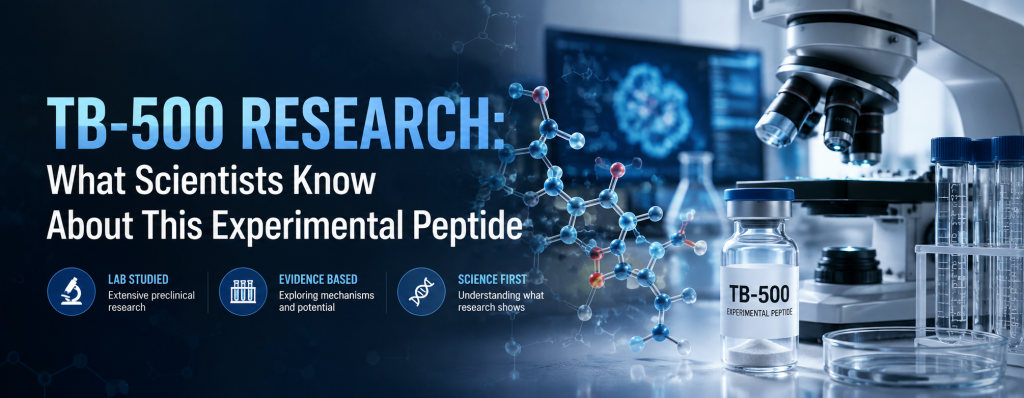
TB-500 is mentioned more in online discussion than in clinical literature. It is a synthetic peptide (an area of study, not a prescription drug) and part of a larger area of research covering tissue repair and regeneration after injury, the migration of cells, the development of new blood vessels, and the regeneration of damaged tissue.
Much of that interest comes from the fact that it is a natural protein called Thymosin Beta-4 that regulates the internal scaffolding that cells use to move. Although TB-500 is derived from Thymosin Beta-4, the two are not the same molecule, and it is important to distinguish between them when interpreting research findings.
As anyone would, it is much better to state clearly at the start: TB-500 isn’t a medically approved medication in the UK, or anywhere else. Most of the evidence available is from cell culture studies and animal studies. Human evidence is limited and available studies are mostly carried out in the presence of the full-length protein instead of the synthetic fragment. This article summarises what current research shows-and, equally importantly, what it does not.
What Is TB-500?
TB-500 is a synthetic peptide, designed for laboratory study. It is often referred to as the acetylated 7-amino-acid fragment, which is typically represented as Ac-LKKTETQ, a small region of a much larger molecule called Thymosin Beta-4.
The LKKTETQ sequence has been investigated because it is believed to contribute to actin-binding activity within the full-length Thymosin Beta-4 protein. This fragment was isolated and synthesised in part to see if the same binding region could lead to the same biological activity as the whole protein.
Some key characteristics:
- Structure: a short synthetic peptide chain, usually provided as a lyophilised powder in the laboratory.
- The protein is encoded by the TMSB4X gene and is known as thymosin Beta-4, a 43-amino-acid protein.
- Origin: chemically synthesised (not derived from human or animal tissue)
- Status: a research compound, NOT a licensed pharmaceutical product
Thymosin Beta-4 is naturally found in the body, especially in platelets and wound fluid. It is best characterized as a G-actin sequestering protein that binds to free actin monomers and regulates the ratio of free actin to the filamentous actin that is used to shape cells and to provide the means by which cells move. This has been a longstanding interest for wound biology owing to the fact that movement of cells is essential for healing.
TB-500 vs Thymosin Beta-4
These two names are used interchangeably across a great deal of online material, which has created persistent confusion. The table below sets out the main differences.
| Feature | TB-500 | Thymosin Beta-4 |
|---|---|---|
| Structure | Short synthetic fragment, commonly described as Ac-LKKTETQ | Complete polypeptide with a defined three-dimensional behaviour in solution |
| Length | Approximately seven amino acids | 43 amino acids |
| Origin | Laboratory synthesis | Naturally produced by human and animal cells |
| Natural occurrence | Does not circulate as an independent molecule in the body | Widely distributed, notably in platelets and wound fluid |
| Research focus | Largely preclinical; frequently discussed outside formal research settings | Extensive preclinical work plus some early-phase clinical investigation |
| Human studies | No substantial published clinical trial programme | Small early-phase trials, including ocular and dermal wound research |
| Biological role | Studied as a fragment intended to reproduce actin-binding activity | Established role in actin regulation, cell migration and tissue repair biology |
The scientific implication is straightforward. The studies mentioned in the source cited “TB-500” which are often researched are actually studies on full-length Thymosin Beta-4. A fragment may have a binding motif to its parent protein and not have the same stability or distribution or full activity. The findings of one are not scientifically sound for the other, and it’s one of the most prevalent mistakes in popular reporting on this peptides.
How Does TB-500 Work?
The mechanisms below are based on laboratory studies of Thymosin Beta-4 and its actin binding-region. They refer to processes observed in experimental models, not recognized effects in humans.
Actin regulation
Actin is found in two forms: G actin is the free monomer and F actin is the filament that is formed when monomers assemble. It is the assembly and disassembly that make it possible for a cell to change shape, to extend out and to pull itself along. Thymosin Beta-4 binds G-actin and serves as a reservoir, affecting the availability of actin filaments. The fragment came under research focus due to its central role in the interaction, which includes the LKKTETQ actin-binding sequence.
Cell migration
All movement is related to the dynamics of the cytoskeleton. Laboratory studies have looked at the effects on various cells that play a role in repair, such as fibroblasts (which form connective tissue), endothelial cells (which line blood vessels) and keratinocytes (which resurface skin). The overwhelming majority of the published evidence base is based on migration assays in cell culture.
Angiogenesis
Blood supply is required for new tissue. The idea of Thymosin Beta-4 as a factor which affects the development of new vessels has been explored, such as studies of VEGF signalling and endothelial cell behaviour. While repair is a normal and necessary process of angiogenesis, it is also a process of great biological implication, which is described below.
Inflammatory signalling
There is a close association between repair and inflammation. There has been a study of effects on the production of cytokines and inflammatory pathways in experimental models to better understand the interaction of the protein with immune signalling in the early stages of tissue injury. These are still lab-generated systems and not observed clinical results.
Current Areas of Scientific Research
Tissue repair
Preclinical studies have focused on examining how skin, tendon, muscle, and ligament (and other pathways) respond to injury (usually in animal models or cultured cells). Biomarkers of cellular activity and structural recovery have been studied. Again, these are pre-clinical models, which are selected for their tractability and not for their predictive value in humans.
Wound healing research
This is the most developed area. Studies have been conducted on epithelial healing, remodelling of the extracellular matrix, collagen structure and movement of fibroblasts. Full-length Thymosin Beta-4 has been studied in various dermal wound models, including chronic wound models in which normal wound healing mechanisms are impaired.
Cardiac research
After myocardial injury, animal studies have investigated the processes of angiogenesis and cardiac remodelling following ischaemic injury. This sparked strong interest as heart tissue regrows poorly. The results are preliminary and are not intended to represent clinical efficacy.
Eye research
Models of corneal wounds have been employed for the study of epithelial migration and the repair of the ocular surface. The cornea is a convenient research model, due to its accessibility, avascularity and ability to heal in a well described manner. Thymosin Beta-4 has been studied in early phase clinical trials as part of ocular surface disease.
Inflammation research
Outside of wound studies, multiple studies have investigated immune signalling and inflammatory pathways individually, in order to gain insight into mechanism, not treatment.
Regenerative medicine
The overall purpose is conceptual. Whether this molecule is ever to be a treatment or not, understanding the internal scaffolding structure of the cells and interaction with their movement during repair has relevance to tissue engineering, biomaterials and future approaches to regeneration.
What Do Current Studies Show?
Observations of cell migration, tissue regeneration in animal models, angiogenesis, cytoskeletal regulation and inflammatory signalling have been published in the laboratory. Combined these characterise a molecule with potential experimental biological activity.
However, experimental findings should not be interpreted as evidence of clinical effectiveness. Experimental results obtained from cell culture and animal models often don’t make it to humans; this can be due to various factors such as differences in physiology, dosing, delivery, and the complexity of the disease itself. These results do not necessarily represent proven benefits for humans.
Human Research
However, there is little human evidence. Preliminary studies have been performed in certain settings, such as the eye surface and skin wounds, mostly with limited numbers of subjects and with the primary intent of safety and tolerability evaluation.
There is no significant published programme of RCTs for the synthetic TB-500 fragment in particular. It is unknown whether that absence is due to questions of effectiveness, the context of use, or long-term safety and interactions with other conditions. Further, larger and well-designed clinical research is needed for conclusions to be reasonably drawn.
Is TB-500 Approved in the UK?
TB-500 is not approved as a medicine by the UK’s Medicines and Healthcare products Regulatory Agency (MHRA). It does not have any evidence of efficacy for any condition and is not recommended by any NICE guideline.
It is not regarded as a therapeutic agent but rather a laboratory research peptide in regulatory terms. Researchers collaborating with this type of compound will be expected to abide by the ethical approval procedures followed at their institution and all regulatory requirements pertaining to research materials.
TB-500 and Sport
Thymosin beta-4 and its derivatives are on the WADA list of banned substances, and banned at all times (in-competition and out-of-competition). It belongs to the class of peptide hormones, growth factors and mimetics.
It has serious ramifications for those who play in a WADA approved format. There is no evidence that an anti-doping violation brings any performance benefit and no protection if it is not approved by regulations. Competitive athletes should be aware that TB-500 and related compounds are prohibited under the WADA Prohibited List.
Safety Considerations
Questions relating to safety are left open. The areas listed below are under ongoing assessment:
- Long-term safety which is not adequately characterised by an existing dataset.
- Pharmacology: behaviour of a fragment in living systems and clearance.
- Toxicology over the range of exposures of relevance.
- Immune response, such as reactions to a synthetic peptide.
- Theoretical issues brought up by angiogenesis research – because new blood vessel formation has been discussed in the context of tumour biology
That last is an area of scientific debate, not a fact of this compound, and is a testament to the slow nature of regenerative research. There is a lack of robust human safety data; conclusions about safety in either direction cannot be drawn at this time.
Why Scientists Continue Studying TB-500
Research is ongoing due to the underlying biology being truly interesting. Cell motion is at the heart of tissue repair, and tissue repair is at the heart of cell motion, and with cell motion, actin dynamics. An investigation into the mechanism of action of a small molecule that interacts with that system can be achieved by studying that molecule.
The broader fields with which it interacts (such as wound biology, tissue engineering, cellular repair mechanisms and translational regenerative medicine) are fields where much is still to be understood. It is important to understand how to make a compound into a medicine, but that is not the only reason to worth doing research.
Conclusion
TB-500 is an experimental research peptide. Not a licensed medicine in the UK, nor an approved treatment and not recommended by NICE. There is a body of preclinical work – cell culture studies and animal models – documenting interesting biological activity in processes linking to tissue repair.
The only real difference between TB-500 and Thymosin Beta-4 is what it does. Many of the arguments made in favour of the fragment were actually based on the full-length protein and the two are not interchangeable. Anyone reading about this peptide needs to understand which peptide was the molecule studied.
There is a scientific interest that is likely to continue, as the questions raised are beyond this one compound: How do the cells move; how does the tissue rebuild; how can repair be supported? This interest does not necessarily mean there is evidence of benefit, and bigger, well-designed human studies would be required before anything useful could be said about effectiveness or safety in humans.
If you are following this area, it is prudent to follow the primary literature through PubMed and NCBI and regulatory aspects through the MHRA, NICE and WADA.
Frequently Asked Questions
What is TB-500?
TB-500 is a synthetic research peptide derived from a short sequence of the naturally occurring protein called Thymosin Beta-4, which binds with the protein actin. It is usually referred to as the Ac-LKKTETQ. It is not a licensed medicine in the UK or elsewhere, but is manufactured for research use in the laboratory. Research with it shows no evidence of human studies, but instead is preclinical (cell culture, animals).
Is TB-500 the same as Thymosin Beta-4?
No. Thymosin Beta-4 is a complete 43-amino-acid protein which is naturally produced by the body. TB-500 is a short, synthetic polypeptide sequence derived from that protein. Although they share part of the same amino acid sequence, they differ in structure, stability, biological behaviour and research evidence. This distinction is important because a large percentage of the studies that are usually called TB-500 referred to the entire protein.
Is TB-500 approved in the UK?
No. TB-500 has not been approved by the MHRA and is not licensed as a medicine in the UK. It is not recommended by NICE. It is generally categorised as a research peptide. If it is claimed to be an established treatment in anybody's eyes, the claim should be taken with a large pinch of salt as it is not the position taken by the regulators in the UK.
What does TB-500 research investigate?
The biological processes that underlie the way tissue repairs itself - actin regulation, cell migration, angiogenesis and inflammatory signalling - have been the focus of research. Skin and wound models, tendon and muscle injury models, cardiac injury research and corneal repair are some of the applied areas. Almost all of this work is in the preclinical stage, with the goal of understanding mechanism without any clinical applications.
Are there human clinical trials?
The TB-500 fragment does not have a significant published clinical trial programme. Human studies have been performed in a few early phase settings involving the use of full-length Thymosin Beta-4, primarily in the context of the ocular surface and dermal wound environments, and in all cases with relatively small patient cohorts. They do not provide evidence of effectiveness for TB-500 and larger controlled trials would be required to address efficacy and/or safety questions.
Why is TB-500 discussed in regenerative medicine?
Regenerative medicine is the research of how damaged tissue is able to regenerate itself. The actin cytoskeleton plays a key role in cell motion, and cell motion is fundamental to repair, so molecules that interact with actin regulation are of natural interest to the field. TB-500 does not appear in that discussion as a therapy that is established or emerging, but rather as a research tool to investigate mechanism.
Is TB-500 banned in sport?
Yes. World Anti-Doping Agency bans Thymosin Beta-4 and its derivatives, such as TB-500, at all times (in and out of competition). It is part of the group of peptide hormones, growth factors and similar substances. Anti-doping rules are not based on the assumption that a substance has a beneficial effect on performance, so it is not a defence in a case of doping.
Is TB-500 naturally found in the body?
Not as a free-standing molecule. The parent protein thymosin Beta-4 is found naturally and in all human tissue, with significantly higher levels in platelets and wound fluid. That protein has the sequence LKKTETQ in it; however, TB-500 for research use is a synthetic, chemically modified fragment that is not naturally found in the body.
Why do scientists distinguish TB-500 from Thymosin Beta-4?
Doing a sequence does not equal sharing behaviour as sharing a sequence does not equal sharing behaviour. A fragment could bind to the same target as its parent protein but have different stability, distribution, clearance and overall activity. Mixing the two together enables results for an “occurring” protein to be attributed to a “synthetic” compound having a much weaker research history. They need to be kept apart for accurate reporting.
What research remains to be done?
A great deal. Characterising the behaviour of the fragment in living systems, toxicology and long-term safety would be priorities as would be determining whether observations in animal models could be extended to humans or not, and conducting adequately powered randomised controlled trials. Without such a work, any claims for effectiveness among people cannot be backed up with evidence.