Introduction
The human body uses hundreds and thousands of chemical messengers for health and to coordinate all the normal functions in the body. One of the most important is peptides, which are small chains of amino acids that enable cells to communicate, regulate hormones, boost immune function, and impact a variety of other physiological processes. While most people don’t know what peptides are by name, they’re involved in a variety of processes such as appetite, wound healing, sleep, blood pressure, and metabolism.
With the increasing interest in peptide science, so has the public curiosity. Natural peptides and synthetic peptides are often mentioned in articles, documentaries and scientific news without any clarification of what these are. This has been confusing, and is rightfully so. Synthetic peptides are sometimes perceived as artificial and very different from natural peptides, whereas others believe that the natural ones are automatically safer and more effective. The difference, in reality, is much more subtle.
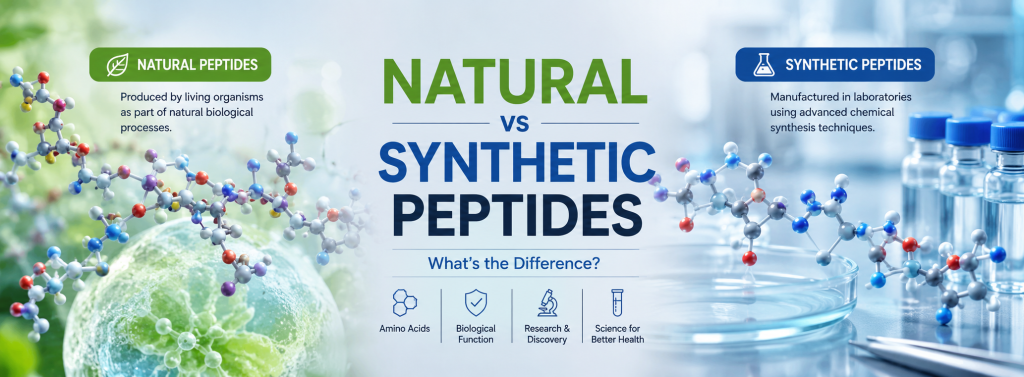
Peptides that are naturally synthesized within the body by living organisms are considered natural. Synthetic peptides are peptides that are produced in a laboratory. Important, a synthetic peptide can be exactly the same amino acid sequence as the naturally occurring one. In other cases, the sequence is deliberately altered to study the mechanisms of a biological system or for stability reasons to aid research.
This distinction is becoming more significant in the current biomedical arena. Synthetic peptides are used to research diseases, investigate cell signalling pathways, create diagnostic tools and design new medicines. Meanwhile, peptides found in nature are still being used to gain insights into how the human body works normally.
This article describes the differences between natural peptides and synthetic peptides in simple terms for the UK audience. It examines the production of each type, their distribution and occurrence, how scientists make peptides in a lab, and why both types have become pivotal to today’s biological and medical research.
What Are Peptides?
To compare natural peptides with synthetic peptides, it is helpful to first know what peptides are.
Peptides are short chains of amino acids, chemically bonded together, called peptide bonds. The proteins are made by the combination of amino acids in various sequences; thus the amino acids are called as building blocks of proteins.
Peptides can be made of anything from two to several dozen amino acids. If these chains are very long and assume complex three-dimensional shapes they are usually called proteins. There is not a definite threshold, but peptides are generally smaller and simpler than proteins.
Peptides have diverse functions throughout the body, and despite their relatively small size.
They may act as:
- chemical messengers
- hormones
- neurotransmitters
- growth regulators
- immune signalling molecules
- antimicrobial compounds
- enzyme regulators
- cell communication molecules
Many peptides are not structural but rather they are biological instructions. They attach to specific receptors on cells that result in an effect that helps keep tissues and organs in balance.
For instance, certain peptides, after a meal, help control blood glucose. Some indicate hunger and/or fullness. Some are involved in immune defence, recognising pathogens that invade the body, others coordinate tissue repair after injury.
This remarkable versatility accounts for the many scientific fields in which peptides are investigated, such as endocrinology, immunology, neuroscience, oncology and regenerative biology.
From Amino Acids to Proteins
Although the terms are sometimes used interchangeably, amino acids, peptides and proteins describe different stages of biological organisation.
- Amino acidsSmall organic molecules
- Peptide bondsTwo or more amino acids join together
- PeptideShort biological chain
- ProteinLonger folded molecule with complex biological functions
The difference lies primarily in length and structural complexity, rather than the individual building blocks themselves.
Why Are Peptides So Important?
Virtually every organ system depends upon peptide signalling.
Some examples include:
Endocrine system
Hormonal peptides regulate blood-sugar, growth, reproduction and metabolism.
Nervous system
Neuropeptides help to transmit information between nerve cells and regulate pain, mood and sleep.
Immune system
Some peptides aid in identifying harmful bacteria, viruses and damaged tissue by helping immune cells to do so.
Cardiovascular system
There are several peptides that play a role in regulating blood vessels and blood pressure.
Digestive system
Peptides regulate food digestion, food intake and nutrient uptake.
Peptides are involved in numerous physiological processes, so any change in their production, no matter how small, can affect the health of an organism. That is how the study of peptide biology is one of the most rapidly expanding fields in Biomedical research.
What Are Natural Peptides?
Peptides that are produced by living organisms naturally are called natural peptides.
Every multicellular organism—including humans, animals and plants—manufactures thousands of different peptides every day. For instance, even bacteria and fungi secrete peptides which facilitate communication with the other cells around them or enables them to protect themselves from other microorganisms that they are in competition with.
Natural peptides are made within a living cell by native cellular processes and not made synthetically.
In cells, larger molecules of protein are initially synthesized as directed by the genes (parts of DNA). These are larger precursor proteins that then undergo a process of specific enzymatic cleavage to yield smaller peptide fragments—small enough to carry out very specific biological functions.
This process is constantly controlled by the body, with the synthesis of different peptides depending on the physiological changes.
For example:
- after eating
- during exercise
- while sleeping
- following injury
- during infection
- in response to stress
Consequently, the synthesis of natural peptides is a very dynamic process and closely associated with normal biological balance.
Where Are Natural Peptides Found?
Natural peptides are found in most tissues in the body.
Major sites include:
Brain
Neuropeptides are involved in controlling memory, appetite, mood, stress response and pain.
Pituitary gland
Secretes growth, reproductive and endocrine regulatory peptides.
Pancreas
Secretes peptide hormones that regulate glucose.
Gastrointestinal tract
Secretes many digestive peptides which affect appetite, digestion and nutrient absorption.
Immune cells
Produce antimicrobial peptides that are a component of the body’s natural immune system.
Skin
Synthesizes protective peptides to fight against invasion of bacteria.
The widespread distribution suggests that peptides are not limited to a single organ, but are integrated in a widespread communication network between multiple physiological systems.
Examples of Naturally Occurring Peptides
Naturally occurring peptides have been identified by scientists at a number of thousand. Some of these circulate around the blood and others are only present in specific tissues.
Here are some common examples.
Insulin
Insulin is known to be one of the most widely studied peptide hormones.
Insulin is a specialized hormone made by special cells in the pancreas that controls how much glucose is in the blood and allows glucose to be taken into the cells. Insulin is generally known for its role in diabetes, but its discovery also revolutionized the study of peptides and helped to understand how peptide hormones control complex metabolic processes.
Glucagon
Glucagon works with insulin to stop blood sugar levels from dropping too low.
Glucagon triggers the liver to break down stored glycogen and release glucose to keep blood sugar levels stable when there is a drop in blood sugar.
Insulin and glucagon do not work alone, but as part of a well-coordinated physiologic system.
Oxytocin
Also known as the “bonding hormone,” oxytocin is a peptide that plays a key role in multiple physiological processes.
It plays a role in childbirth, breastfeeding and some aspects of social behaviour. It is still being studied to see how it is involved in general human psychology and neurological function.
Vasopressin
Vasopressin is used to control the amount of water in the body by helping the kidneys hold on to water.
It also plays a role in the regulation of blood pressure and in cardiovascular homeostasis.
Vasopressin is synthesized in very tightly regulated physiological conditions because it is so critical to life.
Bradykinin
Bradykinin is generated during inflammation and injury to tissue.
It also promotes inflammation by increasing the permeability of vessels and helps to direct inflammatory processes to where they are needed in the body, increasing the ability of immune cells to reach the affected tissues.
Inflammation is a process that is generally perceived as negative, but is a vital component of healthy tissue repair and immune protection.
Endorphins
Endorphins are naturally occurring neuropeptides which are synthesized primarily in the brain and nervous system.
They affect sensitivity to pain and have an adaptive role in promoting wellbeing, especially while exercising or under stressful conditions.
The study of endorphins has made a great contribution to the knowledge of pain control and neurological communication.
How Are Synthetic Peptides Made?
Synthetic is a word that can be misleading. The word “synthetic” is often used in the common discourse to refer to the artificial, unnatural, or even inferior. In peptide science, however, the meaning is a lot easier.
A synthetic peptide is a peptide which has been synthetically manufactured in the laboratory, rather than being synthesized by an organism. Scientists can design a peptide with a carefully controlled amino acid sequence during the manufacturing process, either by using one that is found naturally in the body or by modifying it for special research purposes.
A synthetic peptide might have the same amino acids in the same sequence as the naturally occurring peptide. The sequence could not be separated from the one that was produced in a carefully regulated laboratory setting or one that came from within the body. It is the molecular structure of the peptide and the interaction of the peptide with its target receptor that is important for biology.
Synthetic peptides are generated by researchers when the extraction of adequate amounts from natural tissues is impractical, inconsistent or impossible. Laboratory production can create very pure material and can provide scientists with an opportunity to study a particular question in biology in a repeatable manner.
Why Do Scientists Produce Synthetic Peptides?
Synthetic peptides are widely used in modern biomedical research due to the fact that they are consistent and flexible where natural extraction is not always possible.
A major attraction is the fact that some of the main reasons are:
Understanding Biological Processes
Synthetic peptides are invaluable tools for scientists to study cell-to-cell communication, response of receptors to the presence of signalling molecules, and the mechanisms of biological pathways under various experimental conditions.
For instance, a research lab can learn the effect of a specific peptide in the inflammatory process or immune signaling, without the use of unpredictable biological samples.
Reproducing Naturally Occurring Peptides
There are many naturally occurring peptides which are found in tissues in minute amounts.
It would be very difficult to get sufficient quantities of material for study directly from the body, and would add unwanted variability to the study.
Chemical synthesis can reproduce the identical amino acid sequence almost to perfection, thus providing a material that is identical for repeated experiments.
Improving Stability
After being synthesized, many natural peptides can be quickly degraded by enzymes.
This is an appropriate short life span, since in the body, biological signals frequently need to appear and disappear rapidly. But when the degradation is quick, research may be more difficult in the lab.
Researchers may also make specific changes to the amino acids to make the molecule more stable in an experiment. These changes enable the observation of biological effects over extended periods, whilst studying the behaviour of peptides under controlled conditions.
Investigating Structure and Function
The ability to make small and purposeful changes is one of the biggest advantages of synthetic peptide chemistry.
A single amino acid can be changed and the effect of that change can be compared on receptor binding, stability or biological activity.
The strategy has led to an increased understanding of the relationship between structure and function of peptides.
Supporting Drug Discovery
A wide range of medicines over the last few decades has been based on naturally occurring biological molecules.
Often the initial compound studied is a natural peptide, and then the researchers try to modify it to see if they can develop a characteristic that would make the modified peptide worthy of further drug development.
The article does not deal with medicines, but medicine is an important pathway of research that is linked with natural biology and synthetic chemistry.
How Synthetic Peptides Are Manufactured
Modern peptide manufacturing combines sophisticated chemistry with rigorous analytical testing.
Although the equipment used is highly specialised, the overall manufacturing pathway follows a logical sequence.
Step 1 Designing the Amino Acid Sequence
Each peptide is preceded by its amino acid sequence.
Researchers first determine the correct sequence of amino acids.
- peptide length
- molecular weight
- purity target
- intended research application
A computer can be used to predict the behavior of a molecule before it is synthesized.
This planning phase is crucial as the behaviour of a peptide can change with the change of a single amino acid.
Step 2 Solid-Phase Peptide Synthesis (SPPS)
Solid-Phase Peptide Synthesis (SPPS) is almost the sole method for the synthesis of peptides in the laboratory.
SPPS was invented in the 1960s by the Nobel Prize winner Robert Bruce Merrifield who developed a technique for the rapid and efficient assembly of peptides, amino acids.
This process starts by the first amino acid being coupled to a solid resin.
A series of controlled chemical reactions are then repeated by scientists:
- remove protective groups
- add the next amino acid
- form a peptide bond
- wash away impurities
- repeat until the complete sequence is assembled
As amino acids are linked one by one, the product is under very close control by the researchers.
Highly automated synthesis systems are available today which are capable of producing complex peptide sequences with remarkable precision.
Step 3 Cleavage from the Resin
After the sequence is finished, the peptide that is synthesized stays attached to the solid support.
The peptide is released (or cleaved) from the resin using chemical solutions.
During this step, unwanted reactions are discouraged and/or stopped, and protective chemical groups are removed.
The crude peptide mixture is now ready for purification.
Step 4 Purification
In the first synthesis, not only is the desired peptide usually not the only product, but the amount of impurities is also quite high.
There could also be any small amounts of incomplete sequences or reaction by-products.
Scientists, therefore, purify the material to get rid of these unwanted components.
The most common method of purification is high performance liquid chromatography (HPLC).
HPLC is a separation technique based on the chemical properties of molecules.
Each molecule in the peptide mixture moves at a different speed through the specialised column.
The peptide of interest can then be isolated from contaminants.
High purity is required for research grade peptides as impurities could affect experimental outcome.
Step 5 Identity Confirmation
It is not enough to be pure.
It is also important to prove that the purified molecule is the desired peptide.
The most frequent analysis method is Liquid Chromatography-Mass Spectrometry (LC-MS).
The molecular weight can be determined with very high accuracy by mass spectrometry.
The molecular weight measured by the researchers is compared to the theoretical value obtained from the peptide sequence.
When both agree proof that the molecule has been synthesised correctly.
Step 6 Quality Assessment
Before a peptide is released for laboratory use, several quality checks are commonly performed.
These may include:
- amino acid sequence verification
- purity determination
- molecular weight confirmation
- appearance
- moisture content
- stability assessment
- batch traceability
The exact testing programme depends on the peptide and its intended research application.
Step 7 Freeze Drying
Most research peptides are supplied as a dry powder rather than a liquid solution.
The purified peptide undergoes lyophilisation, also known as freeze drying.
During this process:
- water is frozen
- ice is removed under vacuum
- a stable dry powder remains
Freeze drying helps improve storage stability and simplifies transportation.
Step 8 Batch Documentation
Reputable manufacturers document every production batch.
Typical documentation may include:
- batch number
- manufacturing date
- analytical results
- HPLC chromatogram
- LC-MS report
- storage recommendations
- Certificate of Analysis (CoA)
This documentation allows laboratories to maintain traceability throughout research projects.
Understanding Certificates of Analysis (CoAs)
A Certificate of Analysis (CoA) summarises the analytical testing performed on a specific production batch.
Although the exact format differs between laboratories, a CoA commonly contains:
| Information | Purpose |
|---|---|
| Batch number | Identifies the production batch |
| Peptide name | Confirms product identity |
| Molecular weight | Verifies correct synthesis |
| Purity result | Reports HPLC findings |
| Analytical method | Describes testing techniques |
| Manufacturing date | Supports traceability |
| Storage guidance | Advises appropriate handling |
A CoA helps researchers understand the characteristics of the material they are using and supports reproducibility across studies.
Research Timeline: From Discovery to Modern Peptide Science
Understanding how peptide science evolved provides useful context for today’s research.
- 1900: Scientists begin identifying biologically active peptide molecules within animal tissues.
- 1921: Discovery of insulin revolutionises endocrinology and peptide biology.
- 1950: Improved understanding of peptide hormones and neurotransmitters.
- 1963: Robert Merrifield introduces Solid-Phase Peptide Synthesis (SPPS), transforming laboratory peptide production.
- 1980: Synthetic peptides become increasingly important in immunology, diagnostics and molecular biology.
- 1990: Rapid advances in analytical techniques improve peptide purity and quality assessment.
- 2000: Automation allows increasingly complex peptide sequences to be manufactured efficiently.
- Today: Peptide research supports investigations across endocrinology, oncology, neuroscience, infectious diseases, regenerative biology and precision medicine.
Did You Know?A peptide containing only 20 amino acids can theoretically be assembled in more than one septillion (10²⁶) different sequence combinations.
This enormous diversity explains why peptide science continues to uncover new biological functions and potential research applications.
Natural vs Synthetic Peptides: A Side-by-Side Comparison
It is at this point that one realizes that the difference between a natural peptide and a synthetic peptide is not as much what they are made of as how they are made.
Both are made up of amino acids linked by peptide bonds. Both can have a similar biological interaction. They might even have exactly the same structure of molecules. The major difference is their source; one being synthesized by living cells and the other being built in a controlled laboratory environment.
A few of the features are highlighted in the comparison below.
| Feature | Natural Peptides | Synthetic Peptides |
|---|---|---|
| Origin | Produced naturally by living organisms | Manufactured using laboratory techniques |
| Amino acid sequence | Determined by genetics and cellular processes | Can replicate natural sequences or be intentionally modified |
| Production | Cellular biosynthesis | Chemical synthesis, typically using SPPS |
| Consistency | May vary between individuals and tissues | Highly consistent between production batches |
| Purity | Naturally mixed with many biological molecules | Purified using analytical techniques such as HPLC |
| Quality verification | Controlled by biological regulation | Confirmed through HPLC, LC-MS and batch documentation |
| Availability | Limited to biological production | Can be manufactured repeatedly at larger scales |
| Research role | Understanding natural physiology | Investigating biological mechanisms, diagnostics and drug discovery |
The comparison demonstrates that “natural” and “synthetic” are not indicators of quality or biological importance. Instead, they describe different methods of production.
Examples of Natural Peptides
There are thousands of naturally occurring peptides that have been discovered in humans, animals, plants and microorganisms. Both have very specialised biological roles.
Insulin
Insulin, made in the pancreas, is a hormone that helps control blood sugar levels by allowing glucose to enter the cells. The discovery in early 20th century revolutionized diabetes research and laid the foundation for the study of peptide hormones as an important field of medicine.
Glucagon
Glucagon is used in conjunction with insulin to help keep blood glucose levels within a normal range. If the levels of glucose in the blood drop, glucagon will cause the liver to release stored glucose which helps maintain the body’s energy supply.
Oxytocin
Oxytocin is involved in childbirth, breast feeding and social behaviors. Its effects are still being studied for its role in other areas of neurological signalling, emotional processing, and interpersonal relationships.
Vasopressin
Vasopressin is a hormone secreted by the hypothalamus and stored in the pituitary gland that helps to control water balance and blood pressure. It is a very important in maintaining a normal fluid balance.
Bradykinin
In inflammatory responses after tissue damage, Bradykinin plays a role. Promotes increased permeability of blood vessels, enabling immune cells to get to damaged tissues for healing.
Endorphins
Endorphins are naturally occurring neuropeptides involved in pain modulation and wellbeing. They are liberated during exercises like running, and are thought to be linked to the state of excitement that is experienced by lots of runners, known as the “runner’s high”.
Examples of Synthetic Peptides
Synthetic peptides are synthesized for many scientific applications, such as basic laboratory research to pharmaceutical development.
Examples include:
Laboratory Research Peptides
Many peptides are synthesized solely to study the cellular responses, receptor interactions or biological pathways. They are typically marked Research Use Only (RUO) and are not meant for medical or individual applications.
Synthetic Insulin Analogues
Scientists have developed techniques in peptide chemistry that allow them to produce modified versions of insulin called insulin analogues. These changes have enabled researchers and clinicians to gain greater insights into the insulin’s actions, and have led to development of approved therapeutic products.
GLP-1 Receptor Agonists
Advanced manufacturing methods are used to produce certain peptide based medicines in the fields of metabolic research and clinical use. Some of these are structurally modified naturally occurring hormones, but they are all structurally related.
Diagnostic Peptides
In the laboratory, synthetic peptides are also employed to identify antibodies, analyze immune responses, and for biomedical testing.
Advantages and Limitations
Peptides, whether natural or synthetic, cannot be considered better all the time. They each have unique benefits for particular science questions.
Natural Peptides
Advantages
- Made by the natural means.
- Seamlessly integrated in complex physiological systems.
- Specific biological signalling of a very high quality.
- Provide valuable insight into normal human physiology.
- Of paramount importance to the understanding of health and disease.
Limitations
- May be found in very low levels.
- Quickly broken down by natural enzymes.
- Difficult to obtain in adequate quantities for research.
- Individual variability in biology.
Synthetic Peptides
Advantages
- Precisely defined amino acid sequences.
- High batch-to-batch consistency.
- May be produced on a regular basis within specified conditions.
- High purity after analytical purification.
- Helpful when exploring particular biological processes.
- The design is flexible to enable focussed scientific research.
Limitations
- Requires specialist facilities and skills to manufacture.
- It may get difficult to perform the complex synthesis on longer sequences.
- The condition of the peptides, such as their structure and storage, determine their stability.
- The more complex the sequence, the higher the production cost.
Common Myths About Synthetic Peptides
With the rise in the visibility of peptide science, some misconceptions have arisen. Eliminating these misconceptions can assist to distinguish between fact and popular belief.
Myth #1: Synthetic Peptides are artificial chemicals.
Fact: All synthetic peptides are made from the same amino acids used in natural peptides. The manufacturing process affects the molecule, but not the chemistry of the molecule’s building blocks.
Myth 2: All natural is good.
Fact: When it comes to biology, the word “natural” means nothing more than “made by a living organism. Does not automatically mean greater effectiveness, safety or suitability for all applications. Scientific assessment is based on evidence, not on the terminology.
Myth #3: All Synthetic Peptides Are Medicines.
Fact: Many synthetic peptides are only used for research purposes in the lab. Other products might be used for diagnostics or for authorization as medicines. They serve a purpose which is wholly dependent on their development and regulation.
Myth 4: Scientists can easily extract peptides from Nature.
Fact: An increasing number of naturally occurring peptides are present in small amounts in nature and have a short biological half-life. Laboratory synthesis is a method that is reliable to produce material for scientific investigation.
Myth 5: Synthetic Peptides Substitute Natural Biology.
Fact: Synthetic peptides are not a replacement for natural peptide biology, but a complement. Studies of naturally occurring molecules are undertaken in order to learn about their biological functions in advance of studying synthetic equivalents or modified analogues.
Peptide Research and Regulation in the UK
There is a robust regulatory framework in support of peptide science, with the intention of safeguarding scientific integrity and public health.
In the U.K., several organisations are involved in this framework.
Medicines and Healthcare products Regulatory Agency (MHRA)
Medicines and medical devices are regulated by the MHRA to ensure that they have the quality, safety and effectiveness that is required before they can be authorised for use in clinical practice.
National Health Service (NHS)
The NHS is a high-quality health service that is based on the best available evidence and informed by the latest scientific research. If peptide-based medicines are approved and clinically indicated, they are administered according to existing medical guidelines.
National Institute for Health and Care Excellence (NICE)
NICE assesses clinical evidence and produces guidelines and recommendations to help health services deliver the best treatment and care for patients across England.
Universities and research institutions
The research of peptide biology continues across the UK in the fields of endocrinology, immunology, neuroscience, oncology and regenerative medicine in universities, teaching hospitals and biomedical research centres.
Research Use Only (RUO)
ImportantThere’s one important distinction that exists among peptide science: Research Use Only (RUO).
RUO peptides are only made for research purposes. They are designed to facilitate scientific research, analytical testing and experimental study. They are not registered drugs and not distributed for therapeutic use in people.
This distinction is important for the correct understanding of scientific publications and commercial labels.
Looking Ahead
Peptide science is still a very dynamic field. The development of molecular biology, and structural chemistry and analytical technology, is allowing scientists to ask more complex questions about the biology.
Further studies are anticipated to help to clarify:
- cell signalling networks
- metabolic regulation
- immune communication
- neurological disorders
- precision medicine
- targeted drug design
- biomarker discovery
Each new discovery is based on decades of research of naturally occurring peptides and takes advantage of the precision of synthetic peptide technologies.
Conclusion
Natural and synthetic peptides are well-known to be the opposites, but they are also more related than people imagine.
Natural peptides serve as the blueprints. They show how living entities control many biological processes with a highly accurate molecular communication. Unlike natural peptides, however, it is also possible to synthetically reproduce or modify such molecules in a controlled laboratory environment, where they can be investigated in great detail in a scientific manner.
Finally, it does not matter if one is better than the other, in itself. Instead, it is a blend of two complementary views on the nature of biology. Natural peptides illustrate how life works and synthetic peptides give scientists the tools to learn more about how life works.
The field of peptide science continues to grow and natural and synthetic peptides will be important for biomedical research in the future, aiding in the understanding of human physiology and in the search for new means to understand health and disease.
Frequently Asked Questions
What is the main difference between natural and synthetic peptides?
Natural peptides are those synthesized within the body via natural processes, while synthetic peptides are synthesized in a lab using a controlled chemical process. Both are composed of amino acids connected by peptide bonds.
Can a synthetic peptide be identical to a natural peptide?
Yes. Peptides can be synthesized by scientists with the amino acid sequence identical to that of naturally occurring peptides. Other times, the sequence might be deliberately altered to facilitate research.
Why do researchers use synthetic peptides?
Synthetic peptides offer uniform highly purified material which allows researchers to examine the biological pathways, receptor interaction, diagnostics and molecular mechanisms in a controlled laboratory setting.
What is Solid-Phase Peptide Synthesis (SPPS)?
SPPS is the most popular peptide synthesis technique. Amino acids are coupled to a solid support one at a time and the resulting peptide sequence is known.
How is peptide purity verified?
HPLC is a commonly used instrument for purity evaluation in the laboratory, and LC-MS for confirmation of molecular identity prior to releasing a peptide batch.
What is a Certificate of Analysis (CoA)?
A Certificate of Analysis is a document that summarizes the analytical testing that has been conducted on a particular batch of peptide. Usually consists of purity data, molecular weight, batch identification and testing procedures.
Are all synthetic peptides medicines?
No. Many synthetic peptides are produced just for research and/or diagnostics in the lab. Medicines based on peptides are only authorised for use in people when they have been evaluated by regulatory authorities.
What does Research Use Only (RUO) mean?
Research Use Only means that a peptide has been made for the exclusive use of research. RUO materials are not recommended for use in therapy or clinical practice.
Why are peptides important in biomedical research?
Peptides are able to influence a number of biological processes, such as hormone signaling, immune system responses, metabolism, and communication between the nervous system. The study of them aids research into normal physiology and disease mechanisms.
Why is peptide research growing so rapidly?
In recent years, with the help of advances in molecular biology, analytical chemistry and peptide synthesis, more and more questions are being able to be addressed in the field of biology. Therefore, peptides are still being increasingly used in biomedical research and in the development of new drugs.