Introduction
The terms peptides and proteins are often used interchangeably, but they refer to different types of biological molecules. Both are made from amino acids connected by peptide bonds. However, they differ in size, complexity, three-dimensional structure, and biological roles. Understanding these differences is important for anyone studying biology, healthcare, biochemistry, or biomedical science.
Proteins carry out countless essential functions in the human body, from enzymes that digest food to antibodies that protect against infections. Although generally smaller, peptides are also important. Many serve as signaling molecules, helping cells communicate and regulate processes like growth, metabolism, and immune responses.
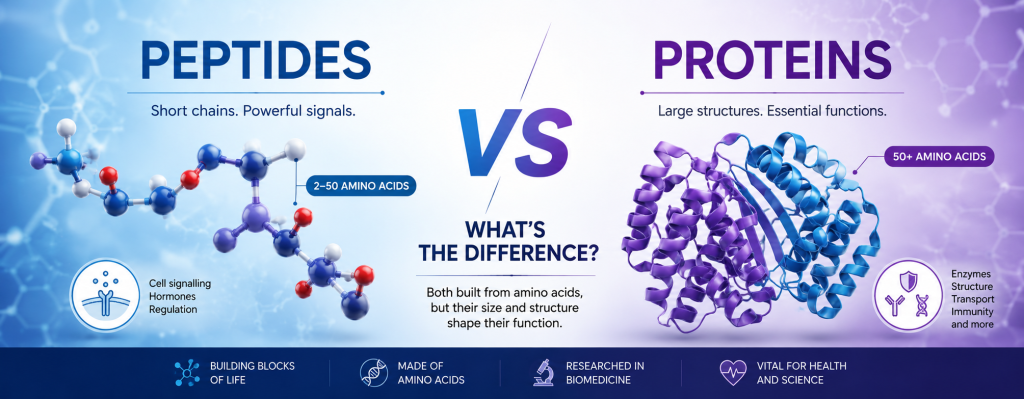
The confusion often arises because there is no clear scientific cut-off. As a general rule, peptides contain around 2 to 50 amino acids, while proteins are usually larger molecules that fold into complex structures. These structures are capable of performing specialized biological functions.
The knowledge of the formation of peptides and proteins from amino acids serves as a basis for molecular biology, genetics, biotechnology, diagnostics and modern medicine research. It also sheds light on why researchers work with these molecules in the lab to learn more about human physiology and disease.
This article explains the difference between amino acids, peptides and proteins, describes the relationship and importance of both to life.
What Are Amino Acids?
Amino acids are commonly referred to as the building blocks of life because they are the building blocks used to build peptides and proteins. Amino acids are essential to the synthesis of molecules used by every living thing to promote growth, repair tissues and maintain normal biological functions.
The 20 standard amino acids are the ones regularly used to synthesize human proteins. They have the same chemical structure, but their R groups are different. These small differences in structure affect the folding of proteins and the way in which they carry out specific biological functions.
Essential and Non-Essential Amino Acids.
The amino acids are typically classified into two categories.
The body is unable to synthesize the required amounts of essential amino acids and so they have to be obtained from food.
Examples include:
-
- Leucine
-
- Lysine
-
- Methionine
-
- Phenylalanine
-
- Tryptophan
The body can make non-essential amino acids.
Examples include:
-
- Alanine
-
- Glutamine
-
- Glycine
-
- Serine
This classification is largely concerned with nutrition, but each of the amino acids also plays a role in the structure and function of peptides and proteins.
How Peptide Bonds Form
A chemical reaction called condensation forms new bonds between individual amino acids.
During this process:
-
- Amino acid molecules join together with the help of the amino group of one molecule reacting with the carboxyl group of another molecule
-
- one molecule of water is released
-
- a peptide bond forms between them
This process is repeated, forming longer and longer chains of amino acids.
Amino Acid + Amino Acid
↓
Peptide Bond
↓
Small Peptide
↓
Longer Peptide
↓
Protein
Why Amino Acid Sequence Matters
The sequence of amino acids that are linked is known as the primary structure.
This sequence determines:
-
- how the molecule folds
-
- which other molecules it can interact with
Whether it forms a signalling peptide or structural protein and whether it will be an enzyme or a receptor.
The structure and final function of the molecule can be influenced by changing just one amino acid. This is the basis of most present day genetics and molecular biology.
What Is a Peptide?
A peptide is a short chain of amino acids that are linked by peptide bonds. The number of amino acids in most peptides is between 2 and 50, but this is just a rule of thumb.
Peptides tend to be simpler in structure than proteins, due to their smaller size. A lot of them do not bend into very complicated 3-D designs. This enables many peptides to bind to receptors or other targets within the cell that play a role in their bio-signalling.
Natural Peptides
Thousands of peptides are produced naturally in the body.
These molecules play a role in the regulation of many normal physiological functions, such as:
-
- communication between cells
-
- hormone signalling
-
- immune responses
-
- nervous system function
-
- regulation of metabolism
Many naturally occurring peptides are synthesized only under special circumstances, enabling cells to react promptly to varying conditions.
Examples of Naturally Occurring Peptides
Several well-known peptides illustrate their diverse biological roles.
Oxytocin
Oxytocin is a peptide hormone that plays a role in childbirth, breastfeeding and social behaviors. It is a molecule that transmits information via receptor binding.
Vasopressin
Vasopressin has effects on kidney function and on blood vessel tone and so plays a role in the regulation of water balance and blood pressure.
Glucagon
Glucagon is made by the pancreas, a specialized organ located behind the stomach that is part of the endocrine system responsible for producing and secreting hormones. The production of glucagon in the pancreas is stimulated by specialized cells. Glucagon plays a role in keeping blood glucose levels normal by signaling the liver to release stored glucose.
Bradykinin
Bradykinin plays a role in inflammatory responses and helps to cause blood vessels to dilate during the process of injury and repair.
These examples illustrate the fact that peptides are frequently involved in the transmission of information between cells and do not make up large structures.
Natural peptides and synthetic peptides.
Not all peptides are produced naturally.
Peptides can also be manufactured and created in the laboratory by controlled manufacturing. Synthetic peptides are used in many applications, including:
-
- molecular biology
-
- analytical chemistry
-
- vaccine development
-
- diagnostic research
-
- laboratory assays
-
- biomedical research
The synthetic molecules enable scientists to study cellular pathways and deepen their understanding of biological mechanisms beyond the use of naturally occurring molecules.
What Is a Protein?
Peptides are smaller and less complex in structure than proteins. They are composed of a series of amino acids, which can be more than 50 in number, but which fold into exact three-dimensional shapes which are necessary for their biological function.
Proteins are generally not linear peptides. Rather, they fold in a well-coordinated manner, which depends on amino acid interactions.
There are several levels of organisation created in this folding:
-
- Primary structure – amino acid sequence
The secondary structure is when coils of amino acids begin to form alpha-helices and beta-sheets due to hydrogen bonding. Secondary structure refers to the hydrogen-bonds between coils of amino acids that start to form alpha-helices and beta-sheets.
Tertiary structure – the final 3-D shape of one protein chain
Quaternary structure – Several polypeptide chains come together to form the functional protein.
How proteins function depends on their final folded shape. Disruption of the folding could cause the protein to lose its normal function or to become unstable.
Some examples are as follows:
Proteins have an amazing variety of functions in the body.
Red blood cells carry oxygen around in haemoglobin.
Collagen supports the structure of the skin, tendons, ligaments and other connective tissues.
Antibodies identify and neutralize bacteria, viruses and other foreign substances.
Digestive enzymes speed up chemical reactions which break down food into nutrients that can be absorbed by the body.
Chemical signals are detected by cell receptors and are used to enable cells to respond to their environment.
The examples show how the proteins are the key working molecules of the body, fulfilling structural, catalytic and regulatory roles that are vital for life.
Peptides vs Proteins: Key Differences
| Feature | Peptides | Proteins |
|---|---|---|
| Typical length | Approximately 2–50 amino acids | Usually more than 50 amino acids |
| Molecular weight | Lower | Higher |
| Structure | Short chains, often flexible | Complex folded three-dimensional structures |
| Folding | Limited or simple | Extensive secondary, tertiary and sometimes quaternary folding |
| Stability | Often broken down more quickly | Generally more structurally stable |
| Biological role | Cell signalling, hormones, regulation | Structural support, enzymes, transport, immunity and metabolism |
| Examples | Oxytocin, glucagon, vasopressin, bradykinin | Haemoglobin, collagen, antibodies, insulin receptor |
| Laboratory analysis | Frequently analysed by HPLC and mass spectrometry | Commonly studied using chromatography, electrophoresis, crystallography and spectroscopy |
| Manufacturing | Often synthesised chemically | Frequently produced using recombinant biotechnology or purified from biological systems |
| Research applications | Cell signalling, biomarker studies, molecular biology | Drug discovery, diagnostics, vaccine research, structural biology and biotechnology |
How Peptides Become Proteins
Peptides and proteins are of varying sizes and complexity, but are on the same continuum of biology. All proteins start off as a sequence of amino acids linked together by peptide bonds. The longer the chain gets the more it folds up to make a stable 3D structure, which may form a working protein.
This evolution is often broken down into four stages:
The units join together to form larger structures, such as proteins, which are made of polypeptides and peptides, which are made of amino acids.
Structural organization of the body from the level of amino acids to peptides.
Cells are able to link individual amino acids together in a particular order, which is the process of protein synthesis. This sequence is defined by genetic information which is stored in DNA and is converted into messenger RNA (mRNA). The genetic code is then translated into the ribosome and the amino acids are joined together in the proper sequence.
Peptides are short chains of amino acids, with a fairly small number of amino acids involved.
Oligopeptides and Polypeptides
The longer the amino acids are added, the longer the peptide chains will grow.
Very short chains are sometimes called oligopeptides, and longer chains can be called polypeptide which could eventually fold up to be functional proteins.
Not all polypeptides are complete proteins, though. Some are intermediate molecules, others are part of larger complexes of proteins.
Why Folding Matters
Biological activity of proteins depends on amino acid sequence. To be functional, a newly formed polypeptide should assume a specific three-dimensional shape.
There are several chemical forces which contribute to the stability of protein folding:
-
- Alpha-helices and beta-sheets are supported by hydrogen bonds.
-
- Disulphide bridges (strengthens the structure) – formed between sulphur-containing amino acids;
-
- Nonpolar core interactions, amino acids with water-fearing R-groups located in the interior of the molecule
-
- Electrostatic attractions take place between two amino acids that are oppositely charged.
These interactions give rise to the specific shape that is necessary for the biological function of each protein.
When Folding Goes Wrong
Protein folding is necessary for proper physiological activity. When a protein misfolds it can be unstable or not function as it should. Protein folding is still a relevant topic in biomedical research because in certain cases, misfolded proteins can be deposited inside the tissues and participate in the development of diseases.
Biological Functions of Peptides
Peptides, while smaller than proteins, have a wide array of biological roles. Many serve as signalling molecules letting cells and organs communicate quickly with each other.
Hormonal Regulation
There are a number of peptide hormones that occur naturally in the body and play a role in coordinating physiology across the body.
Examples include:
-
- Oxytocin
-
- Vasopressin
-
- Glucagon
The hormones interact with specific receptors on target cells to cause precisely regulated biological responses.
Cell Communication
Chemical messengers are constantly secreted to communicate between cells. These are transmitted by peptides, which make sure that tissues react appropriately to the changes in the internal and external environment of the body.
This communication influences:
-
- growth
-
- development
-
- metabolism
-
- stress responses
-
- reproduction
Immune Function
Certain peptides contribute to the body’s innate immune system.
Some antimicrobial peptides occur naturally and are utilized to defend against microbes, including bacteria, fungi and viruses, through methods of disrupting microbial membranes or assisting immune signalling pathways.
The involvement of these molecules in host defence and immune regulation is still being studied.
Inflammation
Peptides also are involved in inflammatory signaling.
Molecules like bradykinin affect widening of blood vessels and coordinate responses after damage to tissue, for instance.
The knowledge of these signalling pathways can be useful for the understanding of normal physiology and inflammatory diseases.
Metabolic Regulation
There are a number of peptide hormones that control energy balance by acting on:
-
- glucose metabolism
-
- appetite
-
- digestion
-
- nutrient utilisation
These signaling mechanisms enable the coordination of the function between different organs in order to achieve metabolic homeostasis.
Wound Healing Research
Peptides that play a role in tissue repair and tissue regeneration are also studied. Laboratory studies investigate the effect of specific naturally occurring peptides on cell migration, collagen production and communication between cells during healing processes.
These studies add to the body of scientific knowledge but do not necessarily mean that they are effective in the clinic.
Biological Functions of Proteins
Proteins are involved in many of the most basic biological functions in the body. They are bigger and more organized than smaller peptides, allowing them to carry out special functions.
Enzymes
Enzymes are many proteins.
Enzymes speed up reactions that would not occur fast enough if they did not have the enzyme.
These include enzymes that function in:
-
- digestion
-
- energy production
-
- DNA repair
-
- cellular metabolism
If there weren’t enzymes, normal functioning of cells would be impossible.
Structural Support
Structural proteins give strength and stability in the body.
Examples include:
-
- Capsules filled with collagen in connective tissues
-
- keratin in hair and nails
-
- The elastin found in skin and blood vessels
The proteins in these gels provide the structural support needed to keep tissues intact, but permit flexibility when necessary.
Transport
Other proteins are used to carry important substances throughout the body.
For example:
-
- Oxygen is transported through the blood in the form of haemoglobin in red blood cells.
-
- albumin is used to carry hormones, fatty acids and other things in the bloodstream
-
- The membrane transport proteins facilitate the movement of nutrients and ions into and out of the cell.
Immunity
Antibodies are special proteins made by special cells of the immune system.
They are able to recognize foreign substances, like bacteria and viruses, and to signal the immune system to look for a potential threat.
This is a highly specific type of recognition that is part of adaptive immunity.
Muscle Contraction
Proteins are involved in interactions that are important for movement.
Inside the muscle fibres, the proteins actin and myosin slide over each other, enabling muscles to make force.
These structural proteins are essential to every voluntary movement, to every heartbeat and to every breathing cycle.
DNA Replication and Gene Expression.
Many proteins control the copying, repair and expression of genetic information.
Examples include:
-
- DNA polymerases
-
- RNA polymerases
-
- transcription factors
-
- DNA repair enzymes
These proteins are responsible for the accurate transmission of genetic information in cell division.
The maintenance and repair of cells.
Cells constantly replace worn out proteins and repair cell structures.
There are numerous special proteins which watch over quality control, clean up damaged molecules and help in the assembly of newly formed proteins.
Peptides and Proteins in Modern Medical Research
Peptides and proteins are now playing key roles in multiple fields of biomedical research. Their structures, interactions and biological activities are studied to enhance knowledge of health and disease.
Importantly, research is aimed at understanding biological mechanisms and not presuming clinical outcomes.
Molecular Biology
Peptides and proteins are studied regularly by scientists to help them better understand how cells communicate, divide and react to their environment.
These investigations help to elucidate the molecular basis of regulation of normal biological processes.
Biotechnology
The recombinant DNA technology can be used in the production of proteins, which are widely employed in modern biotechnology.
These include research reagents, antibodies and laboratory enzymes that help worldwide scientific research.
Diagnostics
Proteins or peptides are used as the biomarkers in many diagnostic tests.
Variations in protein levels can be used to gain insight into physiological processes, which can be used to study disease mechanisms in research and in the clinic.
Vaccine Research
Peptide fragments and proteins can also be examined in the development of vaccines.
Selected regions of proteins are explored for their interactions with the immune system, which helps to increase the understanding of immune recognition and vaccine design.
Drug Discovery
During a pharmaceutical research, peptides and proteins are extensively studied.
Biologists use receptors, enzymes and signalling pathways in vivo and in vitro to characterize naturally occurring molecules and their interactions, then look for analogues that could be drug targets.
These studies are part of the preliminary medicine research and may not be a predictor of the successful use in the clinic.
Precision Medicine
The progress of genetics and molecular biology has raised awareness of the personalised approach in medicine.
The knowledge gained about the action of individual proteins and how genetic variability affects them could help in the future to develop more targeted diagnostic and therapeutic approaches.
When the size changes, why does the biological function change?
The size of a biological molecule is a significant factor in the way that it behaves within a living system.
It is helpful to think of a peptide as a brief instruction note, and a protein as if it were like a full set of instructions.
Short note will convey one particular message in a rapid way.
A detailed manual has several chapters, diagrams and instructions which can perform much more complex tasks.
This is true for peptides and proteins as well.
Molecular Flexibility
Peptides are not very long; many are flexible which means that they can interact nicely with receptors or signalling molecules.
Proteins are bigger and tend to have fixed 3D shapes that enable specialised functions.
Receptor Binding
Numerous peptides act by binding to cell surface receptors, which activate one or more signalling pathways.
Proteins can also act as receptors, but often have other functions as well, such as enzymes.
Tissue Penetration
Smaller molecules may have different movement in biological environments than larger proteins.
The effects of molecular size on tissue distribution, stability and interactions are studied.
Stability
Proteins may have more stable folded structures than peptides.
Many peptides are easily hydrolysed by naturally-occurring enzymes, but larger proteins can persist for longer in the body, depending on their structure.
Folding Complexity
Short peptides do not need much or any long-range folding.
Proteins, however, require very complex secondary, tertiary and in some cases, quaternary structure to function properly.
Structural complexity is directly related to diversity of biological activity.
Common Misconceptions
“Peptides and proteins are identical.”
Not quite. They both consist of amino acids linked by peptide bonds, but proteins are typically more complex, larger molecules with specific functions in the biological system.
All peptides are medicines.
No. Numerous peptides are found in the human body and they act as hormones or signaling agents. Others are synthesised for laboratory studies, diagnostics and biotechnology. They need not be used as therapy.
All proteins are enzymes.
Only one type of protein are enzymes.
There are many proteins that serve structural, transport, immunoregulatory, or cell communication functions and do not have enzymatic activity.
All peptides turn into proteins at the end.
This is incorrect.
Numerous peptides, however, never become larger proteins and have a specific signalling role.
It is better to have larger molecules.
Biology doesn’t work this way.
Small peptides are superb for communicating quick, large proteins are very specialized for structural and catalytic functions. Both are essential.
Synthetic peptides are indeed the same as protein supplements.
They are completely different ideas.
Dietary protein supplements are a source of nutritional protein which is partially digested to yield amino acids. Synthetic peptides are precisely made molecules which are utilized mainly in scientific research and biotechnology.
Suggested Internal Links
Where relevant, link naturally to other educational resources within the DoctorsNHS Knowledge Centre, including:
-
- What Are Peptides? – Introduces peptide biology and their role in the body.
-
- How Peptides Work – Explains how peptides interact with receptors and signalling pathways.
-
- BPC-157 – Discusses current scientific research surrounding this peptide (research overview only).
These internal links help readers explore related topics while strengthening the site’s educational content structure.
Frequently Asked Questions
Are peptides proteins?
No. Peptides and proteins are similar, but not identical. They are formed from amino acids linked by peptide bonds; the difference is that peptides are usually short chains of amino acids when compared to proteins. Generally, peptides are smaller, containing 2-50 amino acids, while proteins are larger molecules that have complex, three-dimensional structures. Other peptides are signals or hormones throughout their life but never protein. This distinction is important in understanding that although these molecules are built out of the same fundamental building blocks, they have different biological roles.
What is the most important difference between peptides and proteins?
The only difference is their size, structure and biological function. Peptides can be relatively short chains of amino acids that can function as signalling molecules, or proteins can be longer chains of amino acids that fold into more intricate shapes that are able to carry out specialised biological functions. A protein folds to create highly organised structures that enable it to function as an enzyme, an antibody, a transport molecule, and/or a structural component. The smaller size of peptides also means that they are usually more flexible and commonly involved in cellular communication without significant secondary or tertiary structure or catalytic function.
How many amino acids make a protein?
The number of amino acids is not a fixed limit but scientists have an idea that molecules with over, say, 50 amino acids are classified as proteins. Chains are typically referred to as peptides if they are shorter. This is primarily a practical classification, not a hard-and-fast rule. Based on function and structure, some molecules at the boundary can be grouped in different ways. The key factor is not just length but whether the molecule adopts a stable three-dimensional structure that can fulfil a specific biological function.
Why do proteins fold, but many peptides do not?
The amino acid chains of proteins are naturally attracted to each other by the formation of hydrogen bonds, hydrophobic interactions, ionic attractions and disulphide bridges. The interactions enable the molecule to adopt a stable three-dimensional form that defines its biological activity. Many peptides are shorter and thus do not have enough amino acids to attain the same complexity of structure. Rather, they tend to be quite flexible such that they can bind to receptors or become part of signalling pathways without extensive folding.
Do humans naturally produce peptides?
Yes. Thousands of peptides are produced naturally in the human body and help regulate normal physiological processes. Examples include peptide hormones that coordinate communication between cells and organs like oxytocin, vasopressin and glucagon. Other naturally occurring peptides have roles in immune, inflammatory, metabolic and nervous system signaling. Scientists are still investigating these naturally occurring molecules to gain greater insight into the way cells communicate and keep themselves functioning properly in various physiological states.
What are the reasons for the relevance of peptides in biomedical research?
Peptides can be used to investigate cellular communication, receptor interaction and molecular signalling pathways. Due to the fact that so many peptides act on very specific targets in the living system, scientists use them to decipher the responses that living cells of animals and humans make to hormones, immune signals and other regulatory molecules. Peptides are also found in a large number of diagnostic applications, in analytical chemistry and biotechnology. While there are significant advances in clinical applications, the study of peptides has contributed to better understanding of molecular biology, drug development and vaccine production and to precision medicine, but it should be noted that despite these advances in the laboratory, molecular research does not always directly lead to human applications.