Introduction
The study of peptides has progressed from being a narrow field in pharmaceutical research to one of the biggest contributors to drug development in contemporary medicine. Peptides have grown to be applied in diabetes, obesity, cancer therapy, orphan disorders, reproductive diseases, osteoporosis, cardiovascular disorders, and targeted drug delivery.
Some of the key reasons for this advancement are due to the successful commercialization of metabolic peptide drugs such as the glucagon-like peptide-1 (GLP-1) receptor agonist. In addition to this, technological advancements in areas like solid phase synthesis, recombinant production, formulation technology, oral delivery, and artificial intelligence have expanded the scope of peptides under evaluation.
The size of the market is quite difficult to estimate as there are different definitions and estimates of it. Some only include approved peptide medicines in the market, while others include insulin, diagnostic peptides, radiopharmaceuticals, and manufacturing services in their estimates.
Current Size of the Global Peptide Therapeutics Market
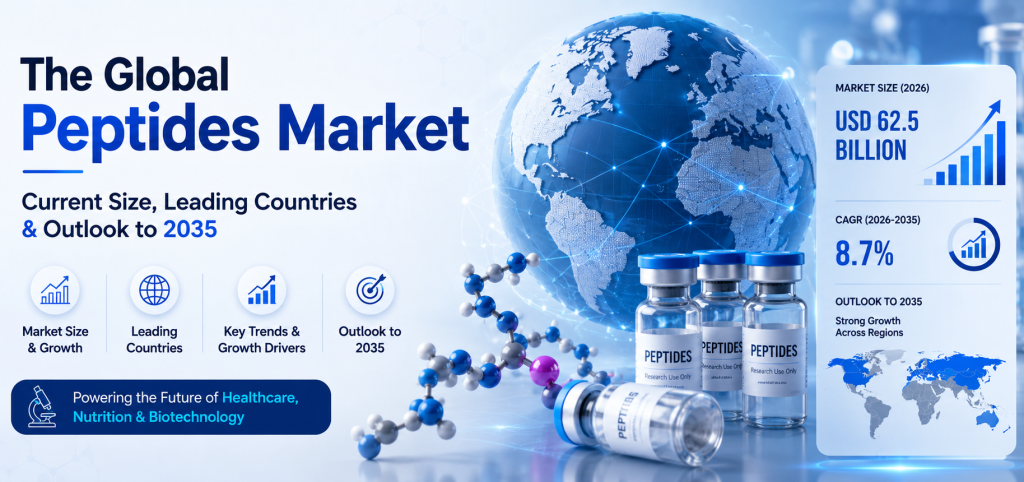
A reasonable, evidence-based estimate places the regulated global peptide therapeutics market at roughly US$47 billion to US$53 billion in 2025.
Recently published estimates include:
| Research estimate | 2025 market value | Forecast value | Forecast period |
|---|---|---|---|
| Future Market Insights | US$46.6 billion | US$144.0 billion | 2036 |
| The Business Research Company | US$49.21 billion | US$83.57 billion | 2030 |
| SNS Insider | US$49.5 billion | US$100.0 billion | 2035 |
| Research Nester | US$51.61 billion | US$138.81 billion | 2035 |
| Precedence Research | US$52.59 billion | US$87.21 billion | 2035 |
Taken together, these figures suggest that around US$50 billion is a sensible central estimate for the global market in 2025.
Some providers report considerably higher numbers. Grand View Research, for example, estimates a 2025 market of US$140.9 billion, and another analysis places it above US$90 billion. These larger figures generally reflect broader definitions that include additional insulin, metabolic, diagnostic or biologic-product revenues. For a conservative pharmaceutical-market view, the US$47–53 billion range is more appropriate than the highest published estimates.
How Large Could the Peptide Market Become by 2035?
Forecasts for 2035 generally place the global peptide therapeutics market between US$87 billion and US$139 billion. A midpoint scenario of roughly US$105–125 billion by 2035 looks credible, assuming continued approvals, expanding metabolic indications, growing oncology applications and improved manufacturing capacity.
Transparency Market Research projects the market could exceed US$123.2 billion by 2035, a compound annual growth rate of about 9.5%. SNS Insider forecasts US$100 billion by 2035, Research Nester projects roughly US$138.81 billion, and Precedence Research offers a more conservative US$87.21 billion.
Practical Market Outlook
| Scenario | Estimated 2035 value | Likely conditions |
|---|---|---|
| Conservative | US$85–95 billion | Slower approvals, pricing pressure and manufacturing limitations |
| Central | US$105–125 billion | Continued metabolic growth and steady oncology and rare-disease approvals |
| High-growth | US$135–160 billion | Wider obesity access, successful oral peptides and rapid pipeline conversion |
| Broad-market definition | Above US$200 billion | Includes insulin, diagnostics, manufacturing and additional biologic categories |
Under the central scenario, the regulated market could add roughly US$55–75 billion in annual revenue between 2025 and 2035.
Why Published Market Figures Differ
The phrase “peptide market” can describe several distinct commercial sectors:
- Approved peptide medicines sold through regulated healthcare systems
- Peptide active pharmaceutical ingredient (API) manufacturing
- Contract development and manufacturing services
- Peptide synthesis instruments, reagents and consumables
- Research peptides supplied to laboratories
- Peptide vaccines, diagnostics and imaging agents
- Peptide-drug conjugates and radioligand products
These categories should not be summed without checking whether individual reports already include overlapping revenue. The peptide-synthesis market alone has been estimated at around US$678 million in 2025, rising to about US$1.44 billion by 2035 under a relatively narrow definition, while a broader manufacturing-services definition runs to several billion dollars.
Peptide-drug conjugates are another fast-expanding submarket. One forecast estimates growth from US$1.24 billion in 2025 to US$7.68 billion by 2035, a compound annual growth rate of roughly 20%.
Leading Peptide Markets by Country and Region
United States
The United States is currently the world’s largest commercial market for peptide therapeutics, supported by high medicine expenditure, strong biotechnology funding, extensive clinical-trial infrastructure, established manufacturers and relatively rapid uptake of innovative metabolic and oncology medicines.
A recent estimate valued the US market at approximately US$21.24 billion in 2025, projected to reach nearly US$34.98 billion by 2035. Another analysis reports that the United States accounts for more than 40% of global peptide-therapy revenue. In 2025, the US Food and Drug Administration reported that more than 130 FDA-approved peptide drug products were designated as reference listed drugs, and the agency has issued specific guidance covering peptide pharmacology, immunogenicity, impurities and generic synthetic peptides. The US is expected to remain the largest national market through 2035, though its share may gradually ease as Asian markets expand.
Europe
Europe is the second-largest regional market. Depending on methodology, its 2025 value has been estimated at roughly US$14.26–16.08 billion. One forecast expects Europe to reach US$27.86 billion by 2035, while another projects US$37.61 billion by 2034.
The primary European markets consist of Germany, France, the United Kingdom, Italy, Spain, Switzerland, Denmark, and the Netherlands. Germany is fortunate to have a large population covered by insurance, manufacturing facilities, and a high uptake of specialist drugs. France is one of the leading prescription drug markets, while the United Kingdom combines an advanced research environment with health technology assessment and procurement centrally. Denmark and Switzerland are of great importance for the pharmaceutical industry due to the presence of major pharmaceutical and biotechnology plants within them despite the small size of their domestic patient populations. Shortages of some GLP-1 receptor agonists have been noted by the European Medicines Agency due to increased demand since 2022.
China
China is likely to be among the fastest-growing major peptide markets over the coming decade. It generated an estimated US$5.69 billion in 2025 and is forecast to reach roughly US$14.09 billion by 2033, annual growth of about 11%, with metabolic disorders remaining a major application. Growth is supported by a large and ageing population, rising metabolic-disease prevalence, expanding domestic biotechnology investment, strong chemical and API manufacturing capability, more locally sponsored clinical trials and government support for pharmaceutical innovation. China has also become an important source of peptide intermediates, APIs and contract-manufacturing capacity, though international regulatory acceptance, quality consistency and global commercial experience remain challenges for some manufacturers.
Japan
Japan has a mature pharmaceutical system, an ageing population and established expertise in peptide chemistry and drug discovery. Its market was estimated at approximately US$2.76 billion in 2025, projected to reach around US$4.8 billion by 2034 (roughly 6.36% annual growth). Japan is expected to stay important for metabolic, oncology, osteoporosis and specialist hospital medicines, with domestic companies and academic laboratories contributing significantly to discovery and formulation research.
United Kingdom
The UK is smaller than the US, Germany or China in direct pharmaceutical sales, but holds an important position in peptide research, clinical development, life-sciences investment and regulatory science. Its strengths include leading universities and biomedical research centres, established early-phase clinical-trial networks, the Medicines and Healthcare products Regulatory Agency (MHRA), a strong contract-research and biotechnology sector, and access to large-scale healthcare data through the NHS. Growth is likely in peptide discovery, clinical research, analytical testing and specialist manufacturing, though reimbursement decisions, NHS budget controls and evidence requirements may moderate the pace of adoption for high-cost medicines.
India
India is set to become increasingly important in peptide API manufacturing, generic development and contract services, helped by a large manufacturing sector, competitive production costs, strong generic expertise, a growing domestic diabetes and obesity burden, and expanding biotechnology and analytical capacity. Its near-term role is likely larger in manufacturing and supply-chain services than in premium branded-drug revenue, but by 2035 domestic demand should grow substantially as access to metabolic and specialist peptide medicines widens.
South Korea
South Korea has a strong biotechnology sector, government-backed research programmes and advanced manufacturing. Its market is expected to grow through oncology, metabolic medicine, cosmetic science and drug-delivery innovation. Although its population is smaller than China’s or Japan’s, it may hold an outsized role in licensing, contract development and biotechnology partnerships.
Australia and Canada
Australia and Canada are attractive regulated markets with high healthcare expenditure, experienced regulatory agencies and rising demand for diabetes and weight-management medicines. Both should show steady growth through 2035. Their direct market sizes will remain below those of the US, China, Japan and the largest European countries, but they are commercially important for their predictable regulatory systems and high per-patient medicine expenditure.
Which Applications Will Drive Growth?
Metabolic Diseases and Obesity
Metabolic medicine is likely to provide the largest single contribution to growth through 2035. The expansion of semaglutide, tirzepatide and future multi-receptor agonists has reshaped the commercial outlook for the entire sector, and demand has already been strong enough to create supply constraints in several countries. The next phase may include longer-acting formulations, oral peptide products, dual- and triple-receptor agonists, combination metabolic therapies, products designed to preserve lean mass, and treatments for associated cardiovascular, renal and liver conditions. The wider obesity-drug market has been projected to reach around US$150 billion annually in the early 2030s, though not all products in that forecast will be peptides.
Oncology
Cancer is expected to remain one of the largest peptide-therapy areas, with peptides serving as active medicines, targeting ligands, vaccine components, imaging agents or carriers for cytotoxic and radioactive payloads. A 2024 scientific dataset identified 28 approved anticancer peptide drugs and a further 80 cancer-related peptides at various stages of clinical development. Peptide-drug conjugates are especially notable, combining selective receptor binding with targeted delivery, and one analysis projects roughly 20% annual growth through 2035.
Rare Diseases and Endocrinology
Peptides are well suited to replacing or modifying naturally occurring signalling molecules, supporting continued development in endocrinology, growth disorders, reproductive medicine and rare metabolic conditions. Even small patient populations can produce commercially significant markets when a medicine addresses a serious condition with limited alternatives.
Cardiovascular and Renal Medicine
Several metabolic peptide medicines are being investigated or adopted beyond glucose control and weight management, so cardiovascular and renal outcomes may expand the addressable patient population for established peptide classes.
Antimicrobial and Immunological Research
Antimicrobial peptides remain scientifically promising because they can interact with microbial membranes and immune pathways. Commercial progress has been slower owing to stability, toxicity, delivery and manufacturing challenges, but improved design methods may yield more viable candidates before 2035.
Technology Trends Shaping the Market
Artificial Intelligence
AI is increasingly used to predict peptide–protein interactions, screen sequences, optimise binding and flag potentially toxic candidates. Recent research has introduced standardised machine-learning datasets and target-conditioned peptide-generation systems intended to accelerate early discovery. These tools still depend on experimental validation, but they may shorten the time needed to identify useful candidates.
Improved Delivery
Traditional peptide medicines are often injected because peptides can be degraded in the digestive system or absorbed poorly. Future growth will depend partly on oral delivery technologies, nasal and transdermal systems, depot formulations, lipidation and half-life extension, cyclisation, nanoparticle and carrier technologies, and targeted peptide conjugates. The availability of oral semaglutide shows that oral peptide delivery is commercially possible, though the formulation requirements remain demanding.
Automated and Greener Manufacturing
Peptide synthesis can require large quantities of solvents, reagents and purification materials. Manufacturers are therefore investing in automation, continuous processing, improved resins, recombinant production and more efficient purification — improvements that will be necessary if high-volume metabolic medicines keep expanding.
Risks That Could Limit Growth
- Manufacturing capacity. Complex synthesis, purification and sterile filling can create bottlenecks; existing GLP-1 shortages show that strong demand does not translate automatically into supply.
- High production costs. Longer or structurally complex peptides can be expensive to manufacture at high purity, and specialised delivery or sterile production raises costs further.
- Stability and delivery limitations. Peptides may have short biological half-lives, poor oral absorption, or sensitivity to temperature and enzymatic degradation.
- Regulatory scrutiny. Regulators assess impurities, immunogenicity, pharmacokinetics and manufacturing consistency; the FDA notes that impurity differences may affect the safety or effectiveness of synthetic peptide products.
- Illegal and unapproved products. The regulated market must be distinguished from unapproved compounds sold online. The EMA warned in September 2025 of a sharp rise in illegal products marketed as GLP-1 receptor agonists that were not authorised and had not met required standards of quality, safety or efficacy. The FDA has likewise flagged insufficient safety information and potential immunogenicity or impurity concerns for several substances promoted through compounding or unregulated channels.
Peptide Market Outlook to 2035
By 2035, the peptide sector is likely to be substantially larger, more technologically diverse and more geographically distributed than it is today. The United States should remain the largest commercial market, Europe should continue to supply a major share of global prescription revenue, and China is expected to record some of the fastest growth among major economies. Japan should remain an important mature market, while India expands its role in manufacturing, generics and contract services. The strongest commercial growth is expected from metabolic medicines, obesity-related indications, targeted oncology, peptide-drug conjugates and improved delivery systems.
A reasonable central forecast is that the regulated global peptide therapeutics market grows from approximately US$50 billion in 2025 to around US$105–125 billion by 2035. More conservative models place it below US$90 billion, while broader definitions produce forecasts above US$200 billion. The most important conclusion is not a single precise number but that peptides are becoming a mainstream pharmaceutical platform rather than a narrow specialist category — and their future value will depend on clinical evidence, regulatory approval, scalable manufacturing, reliable analytical testing and access through regulated healthcare systems.
Key Figures at a Glance
- Estimated regulated global market in 2025: US$47–53 billion
- Central global forecast for 2035: US$105–125 billion
- Published 2035 forecast range: approximately US$87–139 billion
- US market estimate for 2025: approximately US$21.24 billion
- Europe market estimate for 2025: approximately US$14.26–16.08 billion
- China market estimate for 2025: approximately US$5.69 billion
- Japan market estimate for 2025: approximately US$2.76 billion
- Peptide synthesis market in 2025: approximately US$0.68 billion (narrow equipment-and-reagent definition)
- Peptide-drug conjugate market in 2025: approximately US$1.24 billion
- Peptide-drug conjugate forecast for 2035: approximately US$7.68 billion
Frequently Asked Questions
How big is the global peptide market in 2025?
A conservative, evidence-based estimate places the regulated global peptide therapeutics market at roughly US$47–53 billion in 2025, with about US$50 billion as a practical central figure. Higher published numbers usually reflect broader definitions that include insulin, diagnostics or manufacturing revenue.
How large could the peptide market be by 2035?
Published forecasts range from about US$87 billion to US$139 billion. A central scenario of roughly US$105–125 billion by 2035 is credible, while broad-market definitions can exceed US$200 billion.
Which country has the largest peptide market?
The United States, estimated at about US$21.24 billion in 2025 and accounting for more than 40% of global peptide-therapy revenue. It is expected to remain the largest national market through 2035.
Why do market estimates vary so much?
Because “peptide market” can mean different things — approved medicines, API manufacturing, contract services, research peptides, diagnostics or peptide-drug conjugates. Reports using broader definitions naturally report larger totals.
What is driving peptide market growth?
Chiefly metabolic and obesity medicines such as GLP-1 receptor agonists, followed by oncology, peptide-drug conjugates, rare-disease treatments and improvements in delivery and manufacturing.
What could limit growth?
Manufacturing capacity constraints, high production costs, stability and delivery limitations, regulatory scrutiny of impurities and immunogenicity, and the spread of illegal or unapproved products sold online.