Introduction
Every moment, billions of cells in the body exchange information. The biological conversation enables tissue repair, hormone-mediated regulation of metabolism, pathogen identification by immune cells and efficient organ coordination. Among the most significant group of compounds for this process are peptides.
Despite being relatively small when compared to proteins, peptides play highly specialized roles in the biological world. They are signaling agents, signaling molecules and regulators, helping with coordination of various physiological processes.
It is critical to comprehend how peptides function to understand why this class of compounds is becoming one of the fastest growing areas of biomedical research. Researchers continue studying both natural and artificial peptide molecules to gain deeper insight into pathogenesis and cellular communication.
The purpose of this guide is to clarify the principle of peptides function based on scientific literature sources and recognized regulatory organizations. It is intended for educational use only.
Key takeaway: Peptides do not just “do the job.” They provide very specific biological signal influencing cellular response to changes.
What Makes Peptides Biologically Active?
Peptides are formed by chains of amino acids that are linked through peptide bonds.
These peptides consist of:
- A distinct sequence of amino acids
- A distinctive shape
- Specific properties
- Special targets
The sequence of amino acids is responsible for identifying the receptor sites the peptide binds to.
A single change in the amino acid can change all the properties of the peptide.
The selectivity of peptide signaling arises from this unique selectivity of peptides.
The Lock-and-Key Principle
The lock and key analogy is one of the most effective ways to comprehend the functions of peptides.
This model includes the following components:
- Peptide is the key.
- Receptor is the lock.
- The proper key opens the proper lock.
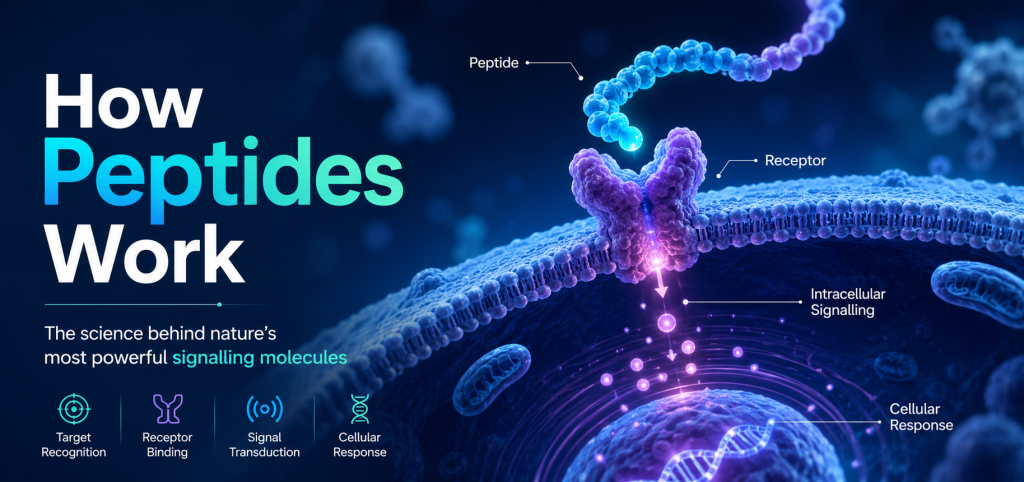
Peptides bind to their receptors and cause some alterations in the structure of receptors. This process triggers a chain of biochemical reactions inside cells.
These reactions affect:
- Gene expression
- Enzymes action
- Hormones release
- Cell growth
- Immune signaling
- Metabolic processes
It is necessary to note that peptides themselves do not initiate actions in cells; they only activate signaling pathways used by cells.
Step-by-Step: How Peptides Work
Peptide Production
Many peptides are naturally produced inside the body.
Examples include:
- Endocrine glands
- Brain tissue
- Immune cells
- Gastrointestinal tract
- Connective tissue
Some peptides are synthesised as larger precursor proteins before enzymes cut them into their active forms.
Release
Cells release peptides when stimulated by:
- Hormonal signals
- Nerve activity
- Nutrient availability
- Tissue injury
- Infection
- Environmental stress
Release can occur locally or into the bloodstream depending on the peptide.
Target Recognition
After release, peptides move about until they meet cells containing receptors to which they can bind.
Most receptors are found on the surface of the cell membrane.
Some peptides may even come into contact with intracellular receptors once they have entered the cell.
Receptor specificity is very important for the effective transmission of biological signals.
Receptor Binding
Binding causes structural changes within the receptor.
Common receptor families include:
- G protein-coupled receptors (GPCRs)
- Receptor tyrosine kinases
- Cytokine receptors
- Ion channel receptors
Each receptor activates different signalling pathways.
Intracellular Signalling
Following receptor activation, cells generate secondary messenger systems such as:
- cAMP
- Calcium ions
- Protein kinases
- Phosphorylation pathways
These molecular events amplify the original signal.
A single peptide binding event may eventually influence thousands of proteins inside a cell.
Cellular Response
The final biological response depends entirely on:
- Cell type
- Receptor density
- Tissue environment
- Existing signalling molecules
Possible outcomes include:
- Increased protein synthesis
- Reduced inflammation signalling
- Hormone secretion
- Cell migration
- Immune activation
- Energy regulation
- Gene transcription
Why Are Peptides So Specific?
While many other conventional drugs have a wide range of effects on several targets, peptides exhibit significant selectivity.
The amino acid sequences of peptides have evolved to bind specific receptors with high precision.
This selectivity makes peptides important research tools because scientists can examine biological processes without affecting others.
Major Biological Systems Influenced by Peptides
Hormonal Regulation
Numerous hormones are peptides.
Examples include:
- Insulin
- Glucagon
- GLP-1
- Oxytocin
- Vasopressin
These molecules help regulate:
- Blood glucose
- Appetite
- Water balance
- Reproductive physiology
- Energy metabolism
Immune System Communication
Immune cells constantly communicate using peptide messengers.
These signalling molecules coordinate:
- Inflammatory responses
- Infection control
- White blood cell recruitment
- Tissue repair
Nervous System
Many neuropeptides function as signalling molecules within the brain.
They contribute to:
- Pain signalling
- Stress responses
- Sleep regulation
- Mood
- Appetite
Digestive Function
The gastrointestinal tract produces numerous peptide hormones that help regulate:
- Digestion
- Gastric emptying
- Nutrient absorption
- Hunger
- Satiety
Tissue Maintenance
Some peptides influence:
- Cell migration
- Structural protein production
- Cellular turnover
- Extracellular matrix regulation
Scientists continue investigating these pathways in laboratory models.
Why Sequence Matters
The alteration in one amino acid can bring about:
- Change in stability
- Alteration in receptor binding
- Modification in biological activity
- Resistance of enzymes
- Half-life
Scientists usually modify the structure of peptides in order to understand how structural changes influence biological function.
This is done in order to enhance knowledge about peptides.
Natural vs Synthetic Peptides
Natural peptides are produced by living organisms.
Synthetic peptides are manufactured using techniques such as solid-phase peptide synthesis (SPPS).
Synthetic versions may:
- Replicate natural peptides
- Improve stability
- Increase receptor selectivity
- Resist enzymatic degradation
- Extend biological half-life
Many remain experimental and are investigated only within controlled research settings.
How Researchers Study Peptides
Modern peptide science combines molecular biology with advanced analytical chemistry.
Common laboratory methods include:
HPLC: Used to assess chemical purity.
LC-MS: Confirms molecular identity and molecular weight.
Mass Spectrometry: Characterises peptide composition.
Cell Culture Studies: Investigate receptor activation and signalling pathways.
Animal Models: Help researchers understand physiological responses before human clinical investigation where appropriate.
Clinical Research: Selected peptides eventually progress through regulated clinical trials before any potential approval.
Why Peptides Are Important in Modern Medicine
There has been substantial growth in peptide discovery in the past two decades.
Peptides are highly valued because they:
- Have high receptor specificity
- Have predictable biological interactions
- Cause fewer side effects than certain small molecules
- Have great translational possibilities
More than sixty peptide drugs have been approved worldwide, while numerous others are currently under development.
Current Challenges in Peptide Research
Although there are many advantages, peptides pose several scientific issues.
Scientific research is still ongoing in improving the following:
- Chemical stability
- Oral bioavailability
- Manufacturing
- Delivery
- Storage
- Cost-effective synthesis
Many of these issues have been tackled through advances in peptide engineering.
Regulatory Considerations
All peptides found on the Internet are not licensed drugs.
Within the UK, medicinal products have to undergo evaluation at the MHRA before their marketing for clinical use.
Peptides are still being researched as investigational compounds.
This point should be considered when reading scientific literature.
Frequently Asked Questions
Are peptides the same as proteins?
No. Peptides are smaller chains of amino acids, and proteins consist of long chains of amino acids and have a more complicated structure.
Do peptides naturally occur in the body?
Yes. There are thousands of peptides existing in nature which regulate normal physiological processes, such as hormone communication, immune system communication, and metabolism.
How do peptides communicate with cells?
Peptides interact with specific receptors in target cells, activating certain cellular signals which modify the behavior of cells.
Why are peptides widely studied?
High selectivity gives these peptides an advantage in researching biological mechanisms and creating drugs for the future.
Are all peptides medicines?
No. There are peptides which have already been registered as drugs, and there are peptides which have not yet left laboratories as investigational compounds.
Final Thoughts
Peptides represent crucial elements of biological communication. Unlike simple chemicals, peptides serve as selective molecules carrying messages responsible for coordinating many processes within cells.
Through their interactions with receptors and the activation of complex signal transduction processes, peptides affect such processes as metabolism, immune responses, hormonal actions, and tissue regeneration. Scientific knowledge about these molecules will further increase due to ongoing innovations in peptide chemistry, molecular biology, and technology.
Further advancements in science will see peptides retaining their role as key participants in biomedical discoveries